For the solo operator doing eveything yourself -
the delivery, the invoicing, the client calls, the follow up
New Book exposes...
...And Fixing It Doesn't Take Becoming A Full-Time Marketer, Hiring A Team,
Or Losing Momentum The Moment Work Gets Busy

Your Stronger Business Starts Here
You’ll receive instant access to your digital copy of
The Client Engine immediately after checkout.
Start Move 1 today.

- Instant Download
- Read on Any Device
- 30-Day Better Decisions Guarantee™
Your Stronger Business Starts Here
You’ll receive instant access to your digital copy of The Client Engine immediately after checkout. Start Move 1 today.
✓ Instant Download
✓ Read on Any Device
✓ 30-Day Better Decisions Guarantee™
From: Rhodri Jones
Swansea, UK
RE: The Client Engine
25th September 2026
Dear Friend,
It’s 4pm on a Thursday, and you’re refreshing your bank balance for the third time today.
Not because you need to. Because some part of you needs to see the number, just to be sure.
Last month was good. Genuinely good, two solid clients, an invoice paid early, maybe even a little breathing room for once. And yet here you are again, doing the same quiet arithmetic in your head: what’s confirmed, what’s still “pending,” what happens if that one big proposal doesn’t land.
If you’ve felt that particular kind of dread, watching a strong month get quietly swallowed by a weak one, you already know something that took me years to learn, and about four months to finally believe.
It isn’t your work. Clients don’t leave because the work is bad.
It isn’t your effort. You already work harder than almost anyone you know.
And it isn’t even your prices, though you’ve probably blamed them more than once at 11pm with a spreadsheet open.
Something else is happening underneath your business. Something that doesn’t show up on an invoice, doesn’t get mentioned on a discovery call, and doesn’t care how talented you are.
The frustrating part? Most solo service providers don’t even realise they’re there. Instead, they assume the problem is themselves. They think they need to work harder.
Post more content. Network more. Learn another marketing strategy. Become better at sales. Raise their rates. Work longer hours.
Yet despite doing all of that, they still find themselves worrying about the exact same things: where the next client is coming from, whether they charged enough, how they’re going to replace the income from a project that’s about to finish, and whether they can afford to turn down a client they already know will become difficult.
It feels like every good month simply buys a little breathing space before the next period of uncertainty arrives.
If that sounds familiar, I want you to know something. It isn’t happening because you’re bad at running a business. It’s happening because your business is quietly making decisions from pressure instead of confidence.
And those are two very different businesses.
Imagine This Instead...
Imagine opening your invoicing software on the first day of the month and already having a good idea what your income will look like. Not because you’ve been lucky with referrals, or because one large client happens to have stayed, but because you’ve deliberately built a business that creates steadier, healthier, more predictable income.
Imagine quoting your fee without the familiar knot in your stomach, without the pause before you hit send, without mentally discounting yourself before the client even replies. Just calmly naming a price you know makes commercial sense, and meaning it.
Imagine turning down the wrong client without immediately worrying about how you’ll replace the income, because you already know the next enquiry is coming.
Imagine finishing a project and, instead of the familiar scramble, already knowing exactly where next month’s work is coming from.
Imagine your partner asking “how’s work?” and being able to give a real answer instead of a reassuring one.
Imagine closing your laptop at 5pm without the automatic urge to check your bank balance one more time, because for once, you already know.
That isn’t wishful thinking. It isn’t reserved for larger agencies, and it doesn’t require a bigger audience, more followers, or a personality transplant.
It’s simply what happens when the structure underneath your business becomes stronger than the pressure sitting on top of it.
The Problem Almost Nobody Talks About
Most solo service providers are running businesses that appear successful from the outside. Clients come in, projects get delivered, invoices are paid, revenue arrives. On paper, everything looks fine.
But underneath that surface sits a completely different story.
A business that’s constantly balancing on one or two clients. Margins that disappear far faster than expected. A pipeline that’s healthy one month and empty the next. Pricing decisions driven more by anxiety than commercial logic. Boundaries that slowly disappear because saying “no” feels riskier than saying “yes.”
It looks like a successful business.
It feels like permanent uncertainty. It’s the version of “business is good” you give when someone asks, even on the weeks it isn’t.
And over time, that uncertainty changes how you make decisions, not consciously, but quietly, almost invisibly.
You begin accepting work you would normally decline. You stop questioning whether a client is genuinely the right fit. You lower your price before anyone has even objected. You avoid difficult conversations because losing the client feels more frightening than protecting your margins.
None of these decisions happen because you’re incapable, they happen because pressure changes commercial judgement.
And once pressure begins making your decisions, your business slowly becomes more fragile with every passing month.
The Hidden Cost Of Structural Fragility
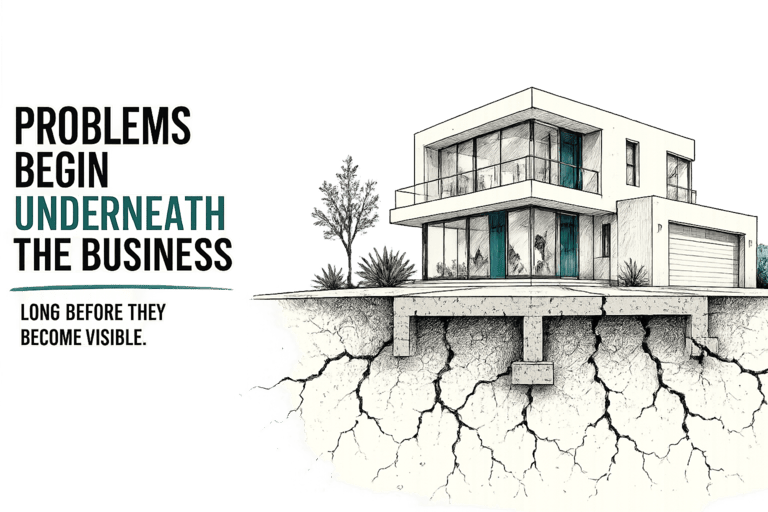
Most business owners think the biggest cost of undercharging is earning less money.
It isn’t.
The biggest cost is what undercharging makes you do next.
It forces you to replace the missing margin with more work. More work leaves less time for marketing, which creates pipeline gaps. Pipeline gaps create financial pressure, and financial pressure makes it harder to say no. Poor-fit clients enter the business, scope expands, and margins shrink again.
The cycle repeats.
Not because you’re lazy or disorganised, but because the structure underneath your business was never designed to withstand normal business events.
A client leaving. A slow month. An unexpected expense. A proposal that doesn’t convert.
Each one lands like a crisis when it should simply be another commercial event.
That’s what I call Structural Fragility.
And once you recognise it, you begin seeing it everywhere.
Why Most Advice Never Solves It
Unfortunately, most advice aimed at freelancers, consultants and solo business owners completely misses the real problem.
You’re told to hustle harder. Post more content. Raise your rates. Find your niche. Build a personal brand. Create more offers. Automate everything. Scale. Hire. Outsource. Delegate.
Some of that advice is useful. Some of it isn’t. But almost none of it addresses the reason those things feel difficult in the first place, because none of them remove the pressure that’s already sitting underneath your business.
Working harder doesn’t fix fragile foundations. It simply places more weight on them.
Raising your rates without changing the way you make pricing decisions often creates more anxiety rather than more confidence. Hiring people before your margins can comfortably support them replaces one problem with another. Even excellent marketing can’t compensate forever for weak commercial decisions.
The real problem isn’t effort. The real problem is structure.
Fix the structure, and many of the decisions that currently feel difficult become surprisingly straightforward.
Which Brings Me To This Book...
Over the last seven years I’ve learned something that completely changed the way I run my own business.
The solo businesses that consistently earn more, keep more, work with better clients, and enjoy far more predictable income aren’t necessarily owned by people who are more talented. They’re usually owned by people making better commercial decisions.
The question is: how do you consistently make better commercial decisions when you’re also doing the delivery, managing the clients, sending the invoices, writing the proposals, marketing your services, and carrying the entire business on your own?
That’s exactly why I wrote The Client Engine.
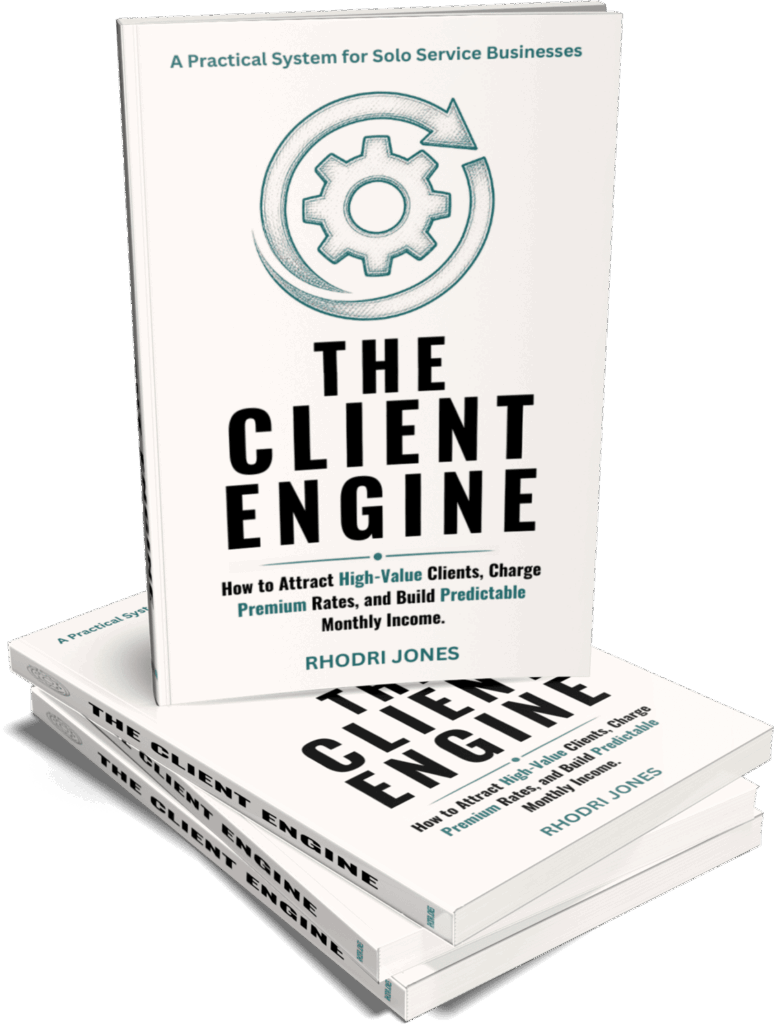
Here's Just A Glimpse Of What You'll Discover Inside The Client Engine...
This isn’t another book full of motivational advice, vague business theory or recycled marketing clichés.
It’s a practical operating manual built around 21 specific commercial moves designed to strengthen the structure underneath your solo business.
Each move solves a problem that’s quietly costing solo service providers money, confidence, time or freedom.
Here are just a few of them…
-
REVEALED: The hidden tax on doing genuinely good work that almost nobody warns solo service providers about... and why being talented and reliable isn't enough to build a financially resilient business. (Starts on Page 7)
-
Why 48% of solo business owners have gone an entire month without income... and the structural reason it keeps happening even to people who work incredibly hard. (See Pages 8-9)
-
The self-reinforcing Pressure loop that quietly makes every pricing, client and workload decision worse the moment money starts feeling tight... and why willpower alone can never break it. (See Pages 8-10)
-
How to calculate your real hourly rate, not the number you put on an invoice, but the one hiding underneath it that determines whether your business is actually profitable. (Page 12)
-
How a perfectly reasonable-looking $1,500 monthly retainer can secretly be paying you less than minimum wage... and the simple audit that exposes it in one sitting. (Page 12)
-
The three predictable causes of margin leakage that quietly drain thousands from solo businesses every year... usually without their owners ever noticing. (Page 15)
-
Why solo operators lose as much as 40% of their working week to invisible work that never appears on a single invoice... and exactly how to identify where yours is disappearing. (Page 15)
-
The four inputs every commercially sensible price should be built from... and why most solo service providers rely on only one of them. (Page 19)
-
The private pricing number every solo operator should know before quoting another project... a number that instantly turns many pricing decisions into an easy yes or no. (Page 22)
-
A real-world example showing how the same piece of work can be worth $1,800 or more than $10,000 a month to different clients... and why understanding that difference changes every pricing conversation you'll ever have. (Page 25)
-
Why freelancers using value-based pricing consistently earn significantly more than those charging by the hour... without working longer weeks. (Page 25)
-
Why most solo providers are terrified of increasing prices with existing clients... and the surprising truth about who usually leaves when those conversations are handled properly. (Page 28)
-
The subtle mistake that makes many service providers sound interchangeable before a client has even asked for a proposal... and the simple shift that completely changes how prospects perceive your value. (Page 31)
-
The six-to-eight questions that quietly separate serious buyers from time-wasters before you ever book a discovery call. (Page 33)
-
The warning signs almost every difficult client shows during the very first conversation... and why financial pressure causes good business owners to ignore them. (Page 36)
-
The uncomfortable question most providers never ask before accepting a new client... even though failing to ask it quietly creates months of frustration later. (Page 39)
-
The four-part project structure that dramatically reduces scope creep before a project even begins. (Page 45)
-
One simple scope boundary script for handling requests outside the agreed scope... without damaging the client relationship or feeling awkward. (Page 48)
-
The five-stage project framework that allows every engagement to run consistently whether you're managing one client or six. (Page 54)
-
The twenty-minute weekly habit that helps ensure a quiet month never begins with an empty pipeline. (Page 57)
-
Why a slow month doesn't automatically mean your prices are too high... and the costly mistake many solo operators make because they assume it does. (Page 60)
-
Why referred clients consistently convert faster, stay longer and become more profitable... and the one moment almost every solo business owner misses when asking for them makes the most sense. (Page 66)
-
The fifteen-minute monthly habit that separates businesses that survive quiet periods from those thrown into crisis by them. (Page 68)
-
And finally...
The three habits that determine whether you've genuinely escaped the feast-and-famine cycle... or whether you're quietly drifting back into it without realising. (Pages 81-85)
(Figures above are drawn from industry research and surveys of solo service providers, freelancers and consultants. Full sourcing is in the book’s Notes and Attributions.)
Seen Enough Already?
Get INSTANT ACCESS To Your Copy Now...
Your Stronger Business Starts Here
You’ll receive instant access to your digital copy of
The Client Engine immediately after checkout.
Start Move 1 today.
- Instant Download
- Read on Any Device
- 30-Day Better Decisions Guarantee™
Your Stronger Business Starts Here
You’ll receive instant access to your digital copy of The Client Engine immediately after checkout. Start Move 1 today.
✓ Instant Download
✓ Read on Any Device
✓ 30-Day Better Decisions Guarantee™
Why I Wrote This Book
My name’s Rhodri.
If you’ve recognised yourself anywhere on this page so far, there’s a reason.
I didn’t write The Client Engine after interviewing hundreds of freelancers or studying someone else’s business model. I wrote it because, for seven years, I lived inside the same pressure you’re probably living with today.
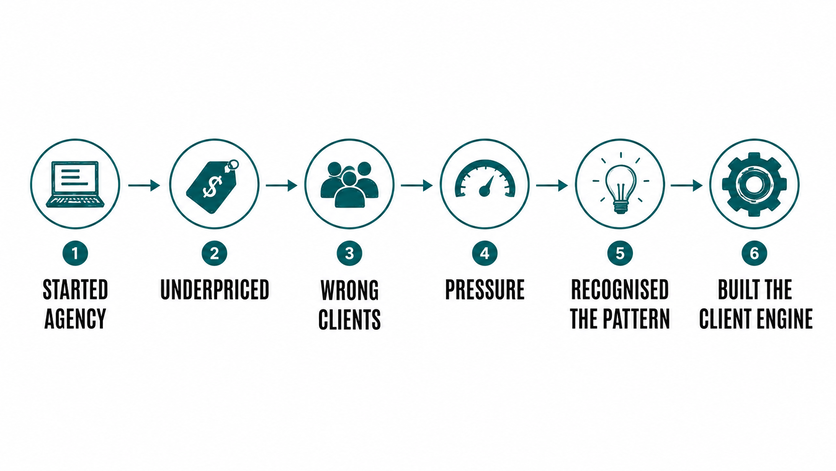
I ran a solo digital marketing agency. Most of the time it was just me, my laptop, and whichever client happened to be shouting the loudest that week.

For a long time my rule for accepting new work was simple. If they wanted to pay, they were in.
Revenue was revenue.
Or at least that’s what I told myself.
When the pipeline feels uncertain, every enquiry starts looking like a good enquiry. So I stopped asking better questions.
Could they actually afford to stay long enough to get results? Were their expectations realistic? Were they genuinely the right client?
Deep down, I knew SEO takes months to produce meaningful results. But I worried that if I told prospects that too honestly, they’d walk away.
So I softened the conversation, avoided the difficult discussions, and took the work anyway.
Some clients constantly micromanaged. Some expected impossible results. Others simply didn’t have the budget to stay long enough for the strategy to succeed.
The relationships almost always ended the same way. Not because the work was poor, but because the foundations were.
And when a client left early, I didn’t just lose the income.
I lost the confidence to make good commercial decisions.
Every enquiry suddenly felt urgent. Every proposal felt like it had to be accepted. Every pricing conversation became a negotiation with myself before it ever became one with the client.
Looking back now, I wasn’t making commercial decisions.
I was making pressure decisions.
I lost three clients within four or five months. I still remember exactly how that felt.
It wasn’t a gradual warning. It landed all at once.
And for the first time, I stopped asking, “How do I replace this client?” and started asking, “Why does one client leaving have the power to throw my entire business into panic?”
That question changed everything.
What Changed
The turning point wasn’t a mindset breakthrough, a motivational seminar, or another marketing course. It was practical.
I found a better way of delivering results, and better results meant I could charge with more confidence. Better pricing created real margins, and real margins created breathing space, the one thing I’d been missing for years.
Capacity.
Capacity to think, to plan, and to choose my clients instead of grabbing at whoever happened to arrive next.
But the biggest change wasn’t visible from the outside. It happened inside my decision-making.
I stopped chasing work. I stopped discounting myself before clients ever questioned my price. I stopped saying yes simply because I was worried about what next month might look like.
The structure underneath my business became stronger.
And everything sitting on top of it became calmer.
Why This Book Is Different
I’m not writing this years later from a comfortable distance. I’m writing it while remembering exactly what those years felt like.
Every one of the 21 Moves exists because I needed it. Every one came from a mistake that cost me either money, confidence, or both.
This isn’t theory borrowed from an agency with sales departments, account managers and operations teams. It’s the practical operating system I wish someone had handed me when it was just me carrying the entire business.
Why You Can Trust Me
I don’t have a story about building a seven-figure agency before retiring to teach other people how to do the same.
That’s not my story.
My story is far more ordinary. And I suspect that’s exactly why you’ll recognise it.
I’ve lived through underpricing. I’ve taken on clients I should have declined. I’ve watched scope creep quietly destroy profitable projects. I’ve experienced the anxiety of wondering where next month’s income would come from. I’ve built four businesses that failed before finally understanding what was really going wrong.
I’m not writing to you as someone looking down from the top of the mountain. I’m writing to you as someone who spent years climbing the wrong one.
And I also know something else.
It doesn’t have to stay that way.
Which Brings Me To This...
Everything you’ve read so far isn’t theory. It’s the system I wish someone had given me seven years earlier.
Instead of learning these lessons through expensive mistakes, you can start where the system already is.
And if it helps you make better commercial decisions than you made last month, it will have done exactly what I wrote it to do.
So let me show you exactly what you get when you order your copy today.
Here's Exactly What You Get Today
When you order your copy of The Client Engine, you’re not buying another business book to read once and leave on your hard drive.
You’re getting the playbook I wish someone had handed me. Practical, unglamorous, and built to actually change how your business runs.
One move at a time. One better decision at a time.

Inside You'll Receive...
✓ The Complete Client Engine
The full book containing all 21 Commercial Moves, arranged in the exact order they should be implemented. Each move focuses on one structural weakness that’s quietly reducing your income, confidence or capacity.
No filler. No motivational chapters. No theory for theory’s sake.
Just practical improvements you can begin applying immediately.
✓ The Four-Week Implementation Plan
Knowing what to do rarely changes a business.
Doing it consistently does.
That’s why The Client Engine doesn’t simply hand you twenty-one ideas and leave you to figure out where to begin. Instead, you’ll follow a structured four-week implementation plan that helps you improve one part of your business at a time. No overwhelm, no trying to change everything in one weekend, just steady, practical progress that compounds.
✓ Immediate Digital Access
The moment your order is complete, your copy is available instantly, no waiting for delivery, no shipping costs, no software to install. Within minutes you could already be working through Move One.
Why I Priced It At Just $9.95
You might actually be wondering: “If this can genuinely help me earn more, why isn’t it $97 or $197 like most business programmes?”
It’s a fair question. The answer is simple.
I don’t want price to become the reason another solo business owner spends another year undercharging, accepting the wrong clients, or worrying about where next month’s income is coming from.
I’d rather remove the barrier. Let you experience the system. And allow the results to speak for themselves.
The Client Engine isn’t a teaser for a “real” programme hiding behind a bigger price tag. This is the complete system.
Everything you need to diagnose the structural weaknesses inside your business, and begin fixing them.
For less than many people spend on lunch.
Think About It For A Moment...
If this book helps you:
- Avoid just one underpriced proposal...
- Win one better client
- Prevent one scope creep conversation
- Retain one valuable client for a little longer
- Or avoid just one unnecessary quiet month
It won’t simply repay its purchase price. It could repay it dozens or even hundreds…
of times over.
That’s the comparison I want you to make.
Not $9.95 versus another business book.
$9.95 versus the cost of one poor commercial decision.
The Better Decisions Guarantee
By now you’ve probably realised The Client Engine isn’t another collection of motivational business advice.
It’s a practical system built from mistakes I made, lessons I learned, and commercial decisions that genuinely changed the way I ran my own business.
I believe in it enough to remove every ounce of financial risk from your decision today.
Read the book. Work through the 21 Moves. Follow the Four-Week Implementation Plan. Apply the ideas to your own business.
Then give them a genuine chance to work.
If, after the next 30 days, you don’t believe you’re making better commercial decisions than you were before you started reading The Client Engine, simply email support@sands.ituk.co.uk.
I’ll refund every penny.
No forms, no awkward conversations, and no trying to persuade you otherwise.
You don’t even need to return the book.
Keep it. Keep your notes. Keep anything you’ve already implemented.
Will a small number of people ask for a refund anyway?
Probably.
I’m comfortable with that. I’d rather trust every genuine customer than build barriers because of the handful who might take advantage.
Running a better business starts with trust.
I think this should too.
If The Client Engine helps you avoid even one underpriced client, one costly commercial mistake, or one unnecessary quiet month, it’ll have paid for itself many times over.
So order today, and start strengthening the structure underneath your business.
And if you don’t believe it’s one of the best investments you’ve made in your business this year, I’ll happily refund every penny.
Frequently Asked Questions
Q: How do I know this will work for me?
A: If you’re a freelancer, consultant, coach or one-person agency who already has clients but wants better ones, better margins and more predictable income, this book was written specifically for you.
It isn’t for complete beginners, and it isn’t written for agencies with departments and sales teams. It’s for people carrying the business themselves.
That’s exactly why the examples feel familiar, the problems feel recognisable and every move can be applied immediately to your own business.
Q: I've read business books before. Why would this be different?
A: Most books stop at the idea, then leave you to work out the implementation yourself.
The Client Engine doesn’t.
Every one of the 21 Moves finishes with a practical action designed to improve your business immediately.
Knowledge rarely changes businesses. Better commercial decisions do.
That’s exactly what this book is designed to create.
Q:Will this help me raise my prices without losing my existing clients?
A: Yes.
But more importantly, it helps you understand why your prices should change in the first place. You’ll build prices you can confidently justify, and learn how to communicate those changes without damaging valuable client relationships.
The clients most solo operators fear losing are rarely the ones who actually leave.
Q: I don't have much spare time. Will this take over my life?
A: No.
In fact, the busier you are, the more relevant this book becomes. The implementation plan was designed specifically for solo business owners with very little spare capacity.
One move. One action. One improvement. Each working day.
Q: What exactly do I receive?
A: Instant access to the complete digital edition of The Client Engine together with the Four-Week Implementation Plan. No shipping, no waiting, no software. Simply download and begin.
Q: Is it suitable if I'm still fairly new in business?
A: If you’ve already begun working with paying clients, yes.
Whether you’re in your first year or your fifteenth, the structural challenges are remarkably similar. The book assumes no prior knowledge of pricing models, financial systems or business theory.
Only a willingness to improve your business one commercial decision at a time.
Q: What if my business is different?
A: The examples vary. The structural problems don’t.
Whether you’re a copywriter, consultant, designer, coach, marketer or another solo service provider, underpricing, scope creep, pipeline inconsistency, and poor-fit clients usually follow the same commercial patterns.
That’s exactly what this book addresses.
Q: Why is it only $9.95?
A: Because I don’t want price becoming the reason another solo business owner spends another year making pressure decisions. I’d rather remove the barrier, allow you to experience the system, and let the value speak for itself.
Q: Is there a money-back guarantee?
A: Absolutely. You’re protected by the Better Decisions Guarantee™.
Read the book. Apply the moves.
If, after 30 days, you don’t believe you’re making better commercial decisions than before you started, I’ll refund every penny. No questions asked.
One Decision. Two Very Different Businesses.
A year from now, your business will almost certainly look different from today.
The only question is whether it will be different because you deliberately changed it, or because the next quiet month forced you to.
Picture the version where you changed it on purpose. Where you know your floor before a client ever asks your rate. Where a slow week is mildly annoying instead of quietly terrifying. Where you’ve said no to two clients this month and it barely registered, because the pipeline’s already full of better ones.
You already know where the current path leads, too.
Another proposal you’ll hesitate before sending. Another client you’ll quietly underprice because losing the work feels riskier than protecting your margins. Another project where the scope gradually expands while the profit quietly disappears. Another promise to spend more time marketing “once things calm down.” Another month where one client leaving changes every commercial decision you make.
None of that happens because you’re bad at what you do. It happens because pressure keeps asking your business to make decisions it was never designed to make.
You don’t need another motivational quote, another productivity hack, or another course telling you to hustle harder. You need a business that’s structurally strong enough to support better decisions.
That’s exactly what The Client Engine was written to help you build.
Not overnight, and not through dramatic changes, but one practical commercial improvement at a time.
One better client. One stronger pricing decision. One healthier boundary. One more predictable month.
Until, one day, you realise you’re no longer reacting to your business.
You’re running it.
This Launch Price Won't Last
$9.95 is the launch price. It won’t stay there.
Once the launch window closes, the price increases, and the version you’re looking at right now disappears for good.
Nothing about the 21 Moves changes if you wait. The price does. And so does the number of quiet months between now and when you actually fix this.
Here's Exactly What To Do Next
Step One
Click the secure button below.
Step Two
Complete your order. It takes less than two minutes.
Step Three
Download your copy instantly. Read Move One. Complete the first action before the day is over.
That’s it.
Tomorrow your business won’t be perfect. But it will be stronger than it is today. And that’s how genuinely resilient businesses are built.
The Biggest Cost Isn't $9.95
The biggest cost is another month spent making pressure decisions.
Another proposal sent at the wrong price, another client accepted because saying “no” felt too risky, another quiet month you could have prepared for, another year of working harder without feeling any safer.
Compared to that, $9.95 is almost irrelevant.
Your Stronger Business Starts Here
You’ll receive instant access to your digital copy of
The Client Engine immediately after checkout.
Start Move 1 today.
- Instant Download
- Read on Any Device
- 30-Day Better Decisions Guarantee™
Your Stronger Business Starts Here
You’ll receive instant access to your digital copy of The Client Engine immediately after checkout. Start Move 1 today.
✓ Instant Download
✓ Read on Any Device
✓ 30-Day Better Decisions Guarantee™
Remember...
You’re fully covered by the Better Decisions Guarantee™. Thirty days, no questions asked, full refund if it doesn’t earn its place.
So the only real risk is spending another year solving the wrong problem.

Rhodri Jones
Your Stronger Business Starts Here
You’ll receive instant access to your digital copy of
The Client Engine immediately after checkout.
Start Move 1 today.
- Instant Download
- Read on Any Device
- 30-Day Better Decisions Guarantee™
Your Stronger Business Starts Here
You’ll receive instant access to your digital copy of The Client Engine immediately after checkout. Start Move 1 today.
✓ Instant Download
✓ Read on Any Device
✓ 30-Day Better Decisions Guarantee™
P.S.
If there’s one thing I hope you’ll remember after reading this page, it’s this.
You probably don’t need to work harder, another qualification, or someone telling you to “believe in yourself.”
What you need is a business that’s built to support better commercial decisions instead of constantly forcing difficult ones.
That’s exactly what The Client Engine is designed to help you build.
One practical move at a time.
Click the button below and grab your copy today
Your Stronger Business Starts Here
You’ll receive instant access to your digital copy of
The Client Engine immediately after checkout.
Start Move 1 today.
- Instant Download
- Read on Any Device
- 30-Day Better Decisions Guarantee™
Your Stronger Business Starts Here
You’ll receive instant access to your digital copy of The Client Engine immediately after checkout. Start Move 1 today.
✓ Instant Download
✓ Read on Any Device
✓ 30-Day Better Decisions Guarantee™
P.P.S.
Think back to the reason you started your business in the first place.
It probably wasn’t to spend your days worrying about where the next client was coming from, discounting work you knew was worth more, or saying yes to projects simply because the pipeline looked a little too quiet.
You went solo because you wanted more freedom.
More control. More choice. More reward for the work you’re already good at.
That’s still possible.
But it starts by changing the structure underneath your business. And that starts with one better decision.
If The Client Engine helps you make better commercial decisions than you made last month, it’ll have done exactly what I wrote it to do.
Click the button below and grab your copy while it’s still available
Your Stronger Business Starts Here
You’ll receive instant access to your digital copy of
The Client Engine immediately after checkout.
Start Move 1 today.
- Instant Download
- Read on Any Device
- 30-Day Better Decisions Guarantee™
Your Stronger Business Starts Here
You’ll receive instant access to your digital copy of The Client Engine immediately after checkout. Start Move 1 today.
✓ Instant Download
✓ Read on Any Device
✓ 30-Day Better Decisions Guarantee™