Solopreneurs stop marketing the moment client work fills the diary, because delivery has a deadline attached to it and marketing does not. When every hour is already spoken for, the task with no immediate consequence is the first one to go. That gap in pipeline activity is exactly what causes the slow month that follows a busy one.
This is not a discipline problem. It is a timing problem, and it is one of the most common patterns among service-based solopreneurs: consultants, freelancers, coaches, designers, and one-person agency owners who are both the delivery person and the rainmaker at the same time.
Why the Pipeline Dries Up During Busy Periods
When you run a one-person service business, there is no separation between the person doing the work and the person finding the next piece of work. Every hour spent on outreach, content, or follow-up is an hour not spent on billable delivery.
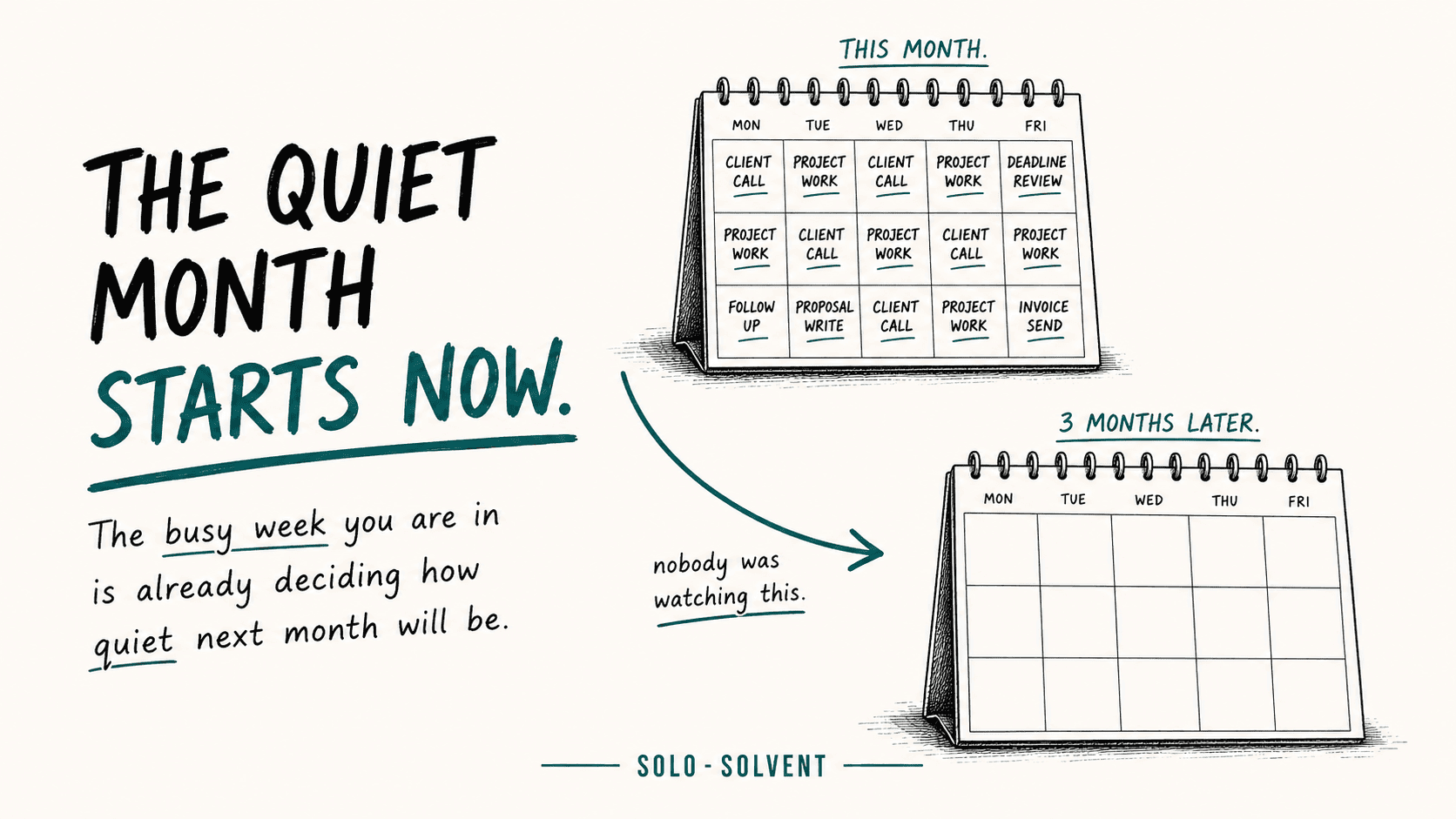
During a quiet patch, marketing feels urgent, so it gets done. During a busy patch, it feels optional, so it gets dropped. The problem is that a busy patch is exactly when the next quiet patch is being decided.
Outreach stops. Content stops. Check-ins with past clients stop. None of this feels like a decision in the moment. It feels like simply not having time. But three or four weeks later, when the current project wraps and the calendar is empty, the connection becomes obvious in hindsight.
This is the mechanic behind the wider solopreneur pressure loop: the feast and famine cycle does not start with the slow month itself. It starts with what gets dropped during the busy one that came before it.
Prefer to Watch?
Here’s a short video breakdown of the main idea and one practical step you can apply today.
This Is Not a Marketing Skills Problem
When the pipeline runs dry, the instinct is to question the marketing itself. Wrong platform. Wrong message. Not posting often enough. Not networking enough.
In practice, this is rarely the real issue. The real problem is that pipeline activity and client delivery are competing for the same hours, and delivery always wins because it comes with a deadline and a bank transfer attached. Pipeline work has neither, so it gets pushed back, again and again, until the well runs dry and it has to be done under pressure instead of on schedule.
The pattern is consistent across service-based businesses: a run of good months, then a scramble to fill the diary, with no clear sense of why it keeps happening. That scramble usually comes with the same feeling, the quiet dread of opening a calendar and finding nothing booked. It is rarely bad luck. It is the direct result of pipeline work being paused during the good months, without that pause ever being noticed as a choice.
Solopreneurs Are Both the Delivery Person and the Rainmaker
This is the specific mechanic that makes the pipeline problem different for a one-person business compared to a larger company. A business with a sales team can keep the pipeline moving while delivery staff focus purely on client work. A solopreneur cannot separate the two roles. Whoever is doing the delivery is also the only person who can do the marketing, which means the two will always compete directly for the same hours unless something forces pipeline activity to happen regardless of workload.

The Habit That Keeps a Solopreneur’s Pipeline Moving
The fix is not a bigger marketing plan. A bigger plan still needs spare hours to run, and spare hours are exactly what a busy month does not have. The fix is a single, specific habit attached to something that already happens in the business without needing to be remembered.
The system: every time an invoice goes out, one pipeline action happens on the same day.
Not a vague intention to catch up on marketing later. One specific action, tied to a moment that already occurs on its own, regardless of how busy the diary is.
In practice, this can look like any one of the following, done once per invoice sent:
- Messaging a past client with a simple line such as, “How’s things going since we wrapped up? Anything on the horizon I could help with?”
- Posting one thing learned that week, in the one place ideal clients already spend time
- Replying properly to a lead that has gone quiet, instead of letting it sit unanswered
The habit works because invoicing already happens without effort. It is baked into running the business. By tying a pipeline action to that existing event, the habit does not depend on memory or motivation during the exact weeks a solopreneur has the least of either.
This does not replace a full pipeline strategy. It is a floor, not a ceiling. It exists to stop the pipeline going completely silent during a busy stretch, so the next quiet period arrives smaller, later, and easier to see coming.
Common Mistakes to Avoid
- Waiting for a quiet moment to restart marketing.
A quiet moment rarely arrives on its own, and by the time it does, the pipeline has already gone cold for weeks.
- Treating pipeline activity as a separate task on a to-do list.
Tasks with no fixed trigger get deprioritised the moment the week gets busy. Pipeline activity needs to be attached to something that already happens.
- Blaming the marketing channel instead of the timing.
Switching platforms or posting styles will not fix a pipeline problem caused by inconsistent effort, not a wrong channel.
- Running pipeline activity only when afraid.
Marketing done purely out of fear, when the diary is already empty, is reactive rather than preventative. It fills the gap late rather than avoiding it.
5. Trying to build a large marketing system all at once.
A complex plan requires spare time that a busy solopreneur does not have. A single, specific habit is more sustainable than an ambitious one that gets abandoned within a month.
Frequently Asked Questions; Pipeline
Why does my pipeline always dry up right after a busy period?
Because marketing is usually the first thing dropped when client delivery fills the diary. The dry spell that follows is the direct result of pipeline activity pausing during the busy stretch, not a separate or unrelated event.
Is a dry pipeline a sign of bad marketing?
Not usually. It is more often a sign of inconsistent timing, where pipeline work only happens when there is spare time or fear driving it, rather than on a fixed schedule regardless of workload.
How much time does a solopreneur need to spend on pipeline activity each week?
Very little, if the activity is attached to something that already happens in the business. A single action tied to an existing event, such as sending an invoice, can maintain pipeline consistency without adding meaningful extra hours.
What is the difference between the pipeline problem and the feast and famine cycle?
The pipeline problem is what causes the famine part of the cycle. A busy month with no pipeline activity directly produces the slow month that follows, which is why the two are connected but not identical. Read more in our feast and famine breakdown.
Can a solopreneur fix pipeline consistency without hiring help?
Yes. The core fix is behavioural, not resourced. Attaching one pipeline action to an existing business event, such as invoicing, does not require budget or additional staff.
Does underpricing make the pipeline problem worse?
It can. A solopreneur charging below their value often needs a higher volume of clients to stay afloat, which leaves even less spare time for pipeline activity. Our guide to solopreneur underpricing covers this in detail.
Read Next
- The Solopreneur Pressure Loop: see how the pipeline problem connects to the other five pressure points in the full framework.
- Feast and Famine Is Not Bad Luck: understand the income cycle that a dry pipeline directly feeds into.
- Why Solopreneurs Underprice: see how pricing fear compounds the pipeline problem by increasing the client volume needed to stay afloat.
Take the Pressure Loop Audit
If pipeline consistency feels like a recurring problem rather than a one-off, it is worth checking where the pressure is actually building. The Pressure Loop Audit is a free, 3/4-minute diagnostic that shows exactly which pressure point needs attention first, before it turns into next month’s slow period.