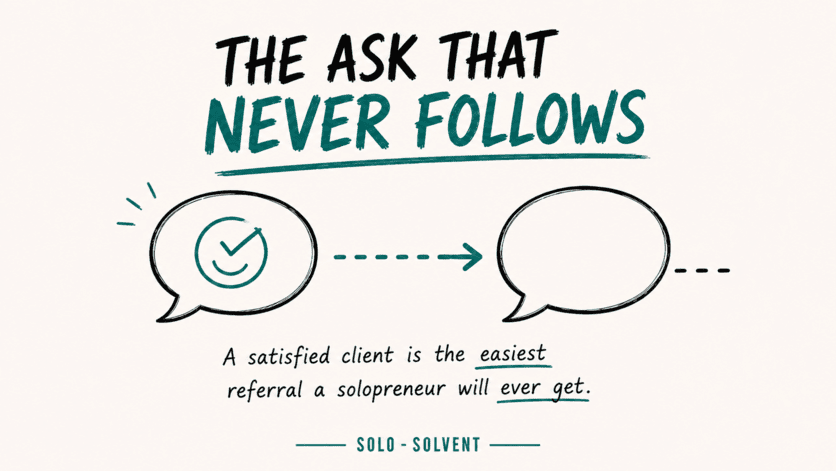
A referral system is a repeatable process for asking existing clients for introductions at the moment they are most likely to say yes, rather than hoping referrals happen on their own. It works because it uses trust you have already earned instead of building trust with a stranger from nothing.
The system has three parts: a clear trigger point, specific wording, and repetition across every client relationship, not just the ones that feel comfortable.
Most solopreneurs already know referrals are valuable. Very few have a system for asking. This article covers exactly how to build one.
Why Solopreneurs Avoid Asking for Referrals
For a service-based solopreneur, referrals are the cheapest, fastest source of new work available. No cold outreach, no unfamiliar buyer to convince, no competing on price with strangers.
Most other inbound sources take longer to build than referrals do, including building visibility that works alongside referrals rather than instead of them. And yet most solopreneurs rarely ask.
The reasons are rarely about the quality of the work. More often it comes down to two things: fear of sounding desperate, and doubt about whether the work was actually good enough to deserve a referral in the first place.
Both of these sit closer to the Solo Tax™ than to any real weakness in the service being delivered, the invisible cost of having no one to check that doubt against.
Running my own agency for seven years, I avoided asking for a long time. I would finish a project, get a happy message back, feel good about it, and move straight on to hunting for the next client instead of asking the one already in front of me.
What eventually shifted things was noticing that clients occasionally referred someone without being asked at all. If the work was good enough to earn an unprompted referral, it was clearly good enough to ask for one directly.
What a Referral System Actually Looks Like
Trying to perform everywhere.
A referral system is different from an occasional referral request. A one-off ask depends on remembering, on the right mood, on the right moment happening to land.
A system removes that dependency by attaching the ask to something that happens in every client relationship, whether the solopreneur feels like asking or not.
There are three parts to a working system:
1.A defined trigger point, a specific moment in the relationship where the ask always happens
2. A specific script, so the ask is never vague or left to improvisation
3 . Repetition across every client, not only the ones who feel easiest to ask
Miss any one of these three and the system stops being a system. It becomes an occasional habit that quietly disappears during busy periods, which is exactly when a solopreneur needs their pipeline working hardest.
A referral system also depends on already having clients in delivery, so it works best paired with the daily habit that prevents the dry spell a referral system alone cannot fix.
Prefer to Watch?
Here’s a short video breakdown of the main idea and one practical step you can apply today.
The Three Referral Trigger Points
The single biggest reason referral asks fail is timing, the same timing problem that referrals are one part of the fix for.
Most solopreneurs ask when the pipeline has already gone quiet, weeks after a project ended, when the client’s goodwill has cooled and the ask suddenly feels like a favour rather than a natural next step.
Trust in a client relationship is not constant. It peaks at specific moments, and those moments are the only ones worth building the ask around.

Trigger one: unprompted positive feedback.
An email, a comment on a call, a message that simply says the work has gone well. This is the single strongest moment to ask, because the client has already told you, without being prompted, that they are satisfied.
Trigger two: project handover or sign-off.
The point where the deliverable is complete and there are no open issues. Trust is high because the relationship has just been proven to work.
Trigger three: contract or retainer renewal.
A client choosing to continue working with you is a second, quieter form of positive feedback. It is also a natural point to introduce a referral conversation without it feeling like a separate, awkward request.
Build the ask into all three moments as a standard step, not something reserved for clients who feel easy to ask.
The Practical Framework: The Three-Trigger Referral System
Here is the full framework, ready to use.
Step 1:
Identify which of the three trigger points has just happened in a current client relationship.
Step 2:
Use consistent wording, adapted only slightly for the situation. A version that works well:
“I’m glad this has worked out well for you. I only take on a small number of clients at a time, so most of my work comes through people like you. If you know one other business owner dealing with the same problem you had before we started, send me their name and I’ll take it from there.”
Step 3:
Name a specific type of person, not a general “anyone you know.” A vague ask gives the client nothing to picture, and without a specific person in mind, the request is forgotten within the hour.
Step 4
Apply this at every trigger point, for every client, without exception. The system only works if it becomes automatic rather than occasional.
This single framework, applied consistently, is what separates a solopreneur who occasionally gets lucky with referrals from one who can count on them.
Common Mistakes to Avoid
- Asking with a vague prompt
“Let me know if you know anyone” is easy to forget because there is nothing concrete attached to it. Name a specific type of person instead.
- Waiting until the pipeline is already thin.
By the time work has gone quiet, the client’s peak goodwill has usually passed, and the ask starts to feel like a favour rather than a natural step.
- Treating it as a one-off request.
A single ask, made once, is not a system. Without a repeatable trigger, referrals go back to happening by accident.
- Only asking clients who feel comfortable to ask.
The clients who feel slightly awkward to approach are often the ones most likely to know someone worth referring. Avoiding them shrinks the system’s reach.
In my own agency, the clients I found hardest to approach were usually the ongoing retainer clients rather than the one-off project clients, and they were often the ones best placed to know someone else needing the same kind of help.
5. Not following up when a referral is given.
A referral that goes unacknowledged, or unfollowed, wastes the goodwill that made it happen and makes the client less likely to do it again.
Frequently Asked Questions
What is a referral system for solopreneurs?
A referral system is a repeatable process for asking existing clients for introductions at specific, predictable moments in the relationship, rather than relying on referrals to happen by chance.
When is the best time to ask a client for a referral?
The best time is at a peak trust moment: unprompted positive feedback, project handover with no open issues, or a contract or retainer renewal.
How do you ask for a referral without sounding desperate?
Ask for one specific type of person rather than “anyone you know,” and frame the request as a normal part of how the business gets its clients, not as a special favour.
Why don’t solopreneurs ask for referrals more often?
The most common reasons are fear of sounding desperate and doubt about whether the work was good enough to deserve one, both of which are usually unfounded once a client has already expressed satisfaction.
How many referrals should a solopreneur expect from one client?
This varies significantly by industry and client type, so there is no reliable universal figure. What matters more than the number is consistency: asking at every trigger point, with every client, over time.
Is a referral system enough to replace other marketing?
On its own, usually not. A referral system works best alongside a minimum pipeline habit, since referrals depend on already having clients in delivery, and a quiet pipeline eventually means no trigger points at all.
Read Next
- How solopreneurs can keep a pipeline warm even during busy client weeks, for the daily habit that prevents the dry spell a referral system alone cannot fix.
- Why inbound leads often depend on chance rather than a repeatable system, for building visibility that works alongside referrals rather than instead of them.
- The structural reason marketing stops the moment client work fills the diary, for the timing problem that referrals are one part of the fix for.
Where This Fits in the Bigger Picture
Referrals are one part of a working pipeline, but they only solve part of the pressure. The Solo Business Pressure Test takes 3 minutes and shows which part of the loop, pipeline, pricing, or something else entirely, is creating the most pressure in your business right now.