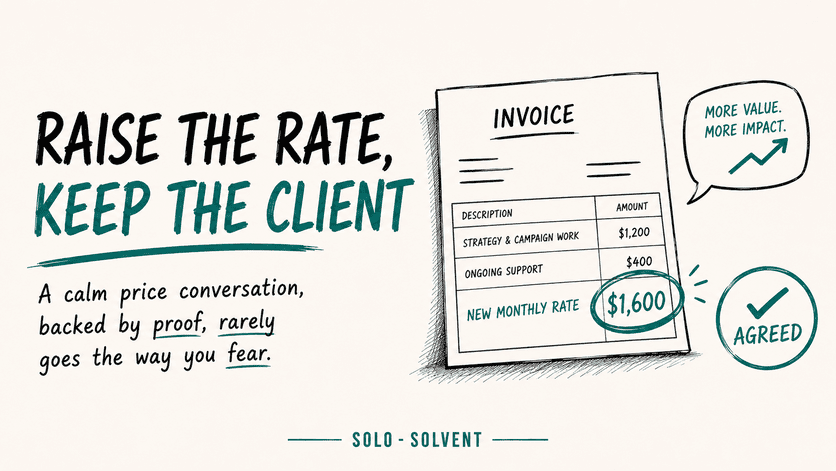

If your rate feels slightly wrong every time you name it, a pull toward lowering the number before the client has even responded, you are not undercharging because you lack confidence. You are undercharging because fear is making the decision before your process gets a chance to. This article explains why solopreneur underpricing happens, what it actually costs over twelve months, and the two-part fix that removes the emotional decision from the pricing conversation entirely.
Prefer to Watch?
Here is a short video breakdown of the main idea and one practical step you can apply today.
Why Solopreneurs Underprice: The Real Reason
Conventional advice tells solopreneurs to raise their rates, know their worth, and back themselves. It is not wrong. But it skips the part that actually matters: why the rate was low in the first place.
For most service-based solopreneurs, pricing is not a calculation. It is a guess made under pressure. There is no structured process between receiving a brief and sending a quote. The number gets picked somewhere in the zone of what feels acceptable, which in practice means the zone of what feels least likely to end in rejection.
That is pricing from fear, not value. And if you are running a service business alone, it is probably the default you keep returning to, particularly in the early years, and again every time a quiet month creates urgency.
The fear driving it is specific. Not a vague lack of confidence, but a very precise one: the fear that naming the right number will end the conversation. That the client will say no, look elsewhere, or decide you are not worth it. So the number shrinks on the way out. A little lower than planned. A few deliverables added to soften the landing. A discount pre-empted before the client has even asked.
None of it is strategic. All of it is self-protection. And it costs far more than the gap between the quoted rate and the right one.
If you recognise this pattern in your own business, understanding how the solopreneur pressure loop works is a useful starting point. Underpricing is one of the most common entry points into it.
What Solopreneur Underpricing Actually Costs
The most damaging thing about underpricing is that it does not look like a crisis. It looks like a quiet shortfall. A margin that is just a bit thin. A month that was almost good enough.
But the cost compounds in ways that are easy to miss in the moment.
The Direct Revenue Gap
Take a straightforward example. A solopreneur charges £800 for a project that should sit at £1,200. The gap feels manageable. Fixable next time.
But next time, the same fear is still in the room. So the quote lands at £900. Slightly better, still not right. And now the £800 engagement has become the internal reference point, which makes the jump to £1,200 feel harder to justify the next time around.
Multiply that gap across every project, every renewal, every new enquiry over twelve months and the number is rarely small. The problem is that no single instance feels like a crisis, which is exactly why it keeps happening.
The Indirect Cost: Wrong Clients, Wrong Margin, Wrong Cycle
The direct revenue gap is only part of the problem. The rest shows up in the type of work the underpriced rate attracts.
Clients who come in at the wrong rate tend to treat the engagement accordingly. They have not paid enough to value it properly. More questions, more scope drift, more resistance when it comes to renewal. And when they leave, which they tend to do sooner, the gap they create pushes the solopreneur straight back into urgent acquisition mode. Drop the rate. Get the next yes. Repeat.
The Pressure Loop Connection
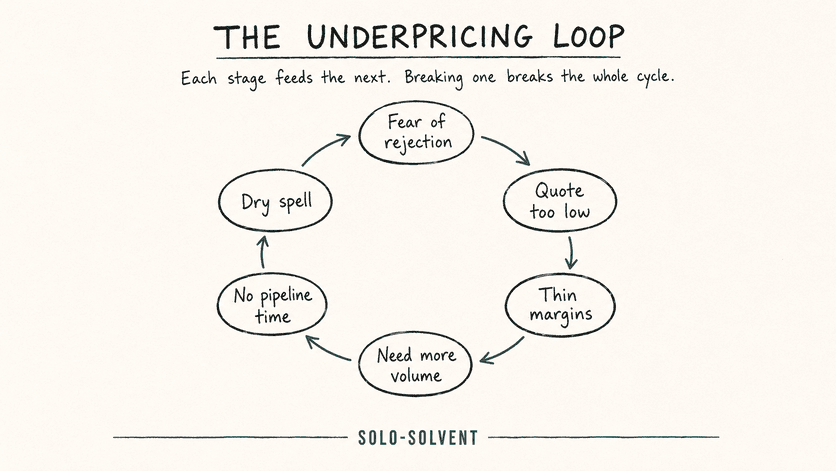
Underpricing feeds directly into the feast and famine cycle that most solopreneurs know too well. Thin margins mean you need more volume to hit the income you need. More volume means no time for pipeline activity. No pipeline activity means the dry spell arrives on schedule. The dry spell creates urgency. Urgency pushes pricing down. And the loop goes around again.
The underpricing is not just a pricing problem. It is the engine of the whole cycle.
This Is Not a Confidence Problem. It Is a Pricing Process Problem.
Here is the reframe that changes how to approach this.
Most advice around solopreneur underpricing treats it as a confidence deficit. Build your confidence, back yourself, believe in your value. That framing is not entirely wrong, but it is not the most useful one, because confidence is hard to manufacture on demand.
The more practical framing: this is a process problem. There is no structure between the brief and the quote. Every pricing conversation starts from scratch, which means every pricing conversation is also a live test of nerve. And when nerve is the deciding factor, fear wins.
A process removes fear from the equation, not by eliminating it, but by making the decision before the anxiety of the moment arrives. The rate exists. The language exists. The solopreneur is executing a system, not making a real-time emotional judgement.
You do not have a discipline problem. You have a pricing process problem. And a process can be fixed.
The Pricing Fix: A Two-Part System
This is a practical system with two components. Both are usable this week without any additional tools, budget or software.
Part One: The Rate Floor
The rate floor is the minimum amount you will charge for a day of work, a project, or a retained engagement. Not the number you hope for. The number below which you do not go.
The rate floor must exist before any pricing conversation takes place. Written down somewhere separate from your quoting process. A note on your phone, a line in a notebook, a sticky note on the monitor. Anywhere it lives before the conversation starts, so it cannot be reduced by the anxiety of the moment.
How to calculate your rate floor:
Work backwards from what you need to earn. Ask yourself three questions:
What do I need to earn in a month to cover my costs and pay myself properly?
What is the maximum number of clients or projects I can realistically carry without burning out?
What is the minimum per client or project that makes those two numbers work?
That third number is your rate floor. Anything below it is not a discount. It is a loss of income, of margin, and often of time you cannot recover.
The rate floor does one important thing: it separates the decision about what to charge from the moment you are being asked. That separation is most of the battle.
Part Two: The Anchor Sentence
The rate floor tells you what to charge. The anchor sentence tells you how to say it.
The moment most solopreneurs lose ground in a pricing conversation is not when they name the number. It is in the thirty seconds before they name the number.
That gap, the silence or the rush to fill it, is where the rate shrinks. Deliverables get listed. Justifications appear. Discounts get pre-empted before the client has asked for one. What started as a price presentation becomes a defence. And the moment you are defending a price, the client knows there is room to negotiate.
The anchor sentence closes that gap. It is said immediately before the number. It does not justify. It reframes the conversation around the outcome rather than the cost.
Here is a version that works for most service-based solopreneurs:
“Based on what you have described, and the result you are looking for, my fee for this is…”
Then the number. Then silence.
No list of inclusions. No pre-emptive softening. No “I can always adjust if that does not work for you.” Just the anchor, the number, and the space for them to respond.
It feels uncomfortable the first time. Less uncomfortable the third time. By the fifth time, it is simply how you price.
Common Mistakes to Avoid
- Treating pricing as a one-off decision
Most solopreneurs set a rate once, feel uneasy about it, and then adjust it reactively, up when they are overbooked, down when they are scared. That is not a pricing strategy. It is an emotional response to circumstances. Build the rate floor once, review it quarterly, and stop making real-time decisions under pressure.
- Justifying the price before anyone has questioned it
The moment you start listing what is included without being asked, you signal that the price might not hold. Clients sense it immediately. Sell the outcome, not the process. What you are doing during the engagement is less important than what it will do for them.
- Filling the silence
Silence after a price is not a no. It is a pause. Most solopreneurs fill it immediately, with a lower rate, an added deliverable, or an offer to discuss. Hold the number. Let them respond. The instinct to rescue the silence almost always costs more than the pause was ever going to. If pushback comes, return to the outcome, not the rate.
- Taking any client to avoid a quiet month
Low-value clients taken out of urgency rarely stay, rarely refer well, and rarely treat the engagement with the respect a properly priced one attracts. A client acquired at the wrong rate to fill a gap tends to create a bigger gap when they leave. The short-term fix extends the cycle.
FAQs: Solopreneur Underpricing
Why do solopreneurs charge less than they should?
The most common reason is the absence of a structured pricing process. Without a rate floor set in advance, pricing decisions get made in the moment under the pressure of wanting to secure the client. In that environment, fear tends to set the rate rather than value.
How do I know if I am undercharging?
A useful signal: if you feel a flinch when you name your rate, a pull toward lowering the number before the client has responded, the rate is probably too low. Another signal: if you regularly feel resentment during engagements, particularly toward the amount of work relative to what you are being paid, the margin is likely wrong.
Does raising rates mean losing clients?
Not necessarily, and not permanently. Clients who leave when a rate increases to a fair level were rarely the right clients at the wrong rate. In practice, solopreneurs who raise rates with a structured process and clear outcome-led positioning tend to find that the enquiries they attract improve as the rate does.
What is the rate floor and how do I set one?
The rate floor is the minimum amount you will accept for a piece of work, set in advance, outside of any specific pricing conversation. Calculate it by working backwards: what you need to earn monthly divided by the number of clients or projects you can sustainably carry. Anything below that number is a loss, not a discount.
How do I hold my rate when a client pushes back?
The most effective approach is not to justify the number but to return to the outcome. “The fee reflects the result you are looking for” closes more conversations than a detailed breakdown of deliverables. If pushback continues, the question to ask is whether this client is the right fit at the right rate, not whether the rate should change.
Is underpricing a confidence problem?
Partly, but treating it as a confidence problem alone makes it harder to solve, because confidence is difficult to manufacture on demand. It is more useful to treat it as a process problem. A rate floor and a practised anchor sentence remove the real-time emotional decision from the conversation. When the process is solid, the confidence tends to follow.
Read Next
Understanding the full solopreneur pressure loop. Underpricing is one part of a self-reinforcing system. This article names all six pressure points and explains how they connect.
How the Solopreneur Pressure Loop Works
The feast and famine cycle. Thin margins from underpricing feed directly into income instability. If the pricing problem and the income problem feel connected, they are.
The Feast and Famine Cycle: Why Solopreneurs Are Trapped in It and How to Get Out
Take the Solo Business Pressure test
If underpricing is costing you but you are not sure where it sits in the bigger picture of your business, the Solo Business Pressure Test will show you. It is free, takes around ten minutes, and gives you a clear picture of which part of the loop is doing the most damage right now.