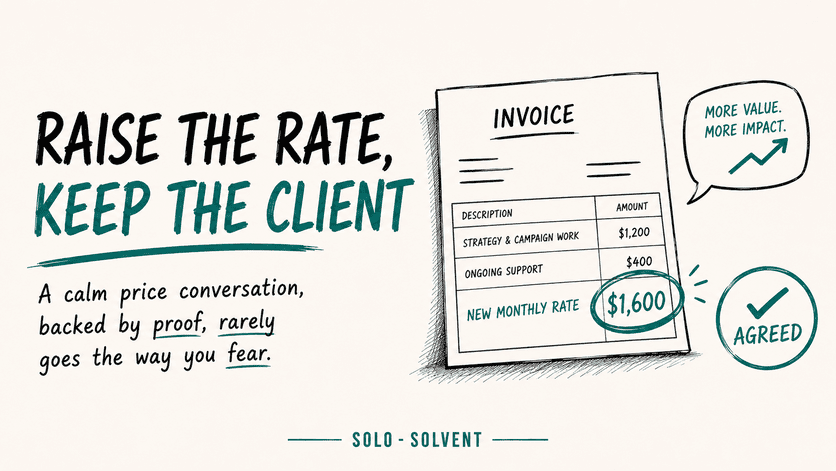
Raising your rates rarely costs you the client you are afraid of losing. What actually determines the outcome is whether you raise the price with proof behind it or with only nerves behind it. This applies whether you invoice as a freelancer, a consultant, or a coach: build one piece of real evidence first, lead the conversation with that evidence, then state the new rate once, clearly, without apologising for it.
That is the short version. The rest of this guide covers how to build that evidence, how to time the conversation, and exactly what to say.
Why Freelancers Underprice in the First Place
Most freelancers do not set their rates too low because they cannot do the maths. They set them too low because the price was decided from fear rather than value. A quiet voice says the client will leave if the number goes up, so the number stays where it is, year after year, even as the work gets better.
This is the mechanic behind the Pricing Trap™: financial pressure causes underpricing, underpricing keeps margins thin, thin margins keep the pressure high, and the cycle holds itself in place. If you want the fuller picture of how this pattern forms, our guide on why solopreneurs underprice breaks down the underlying causes.
The fix is not more confidence. It is more evidence. Confidence built on nothing collapses the second a client hesitates. Confidence built on a real result holds, because you are not asking the client to trust your feelings. You are showing them a fact.
However you invoice, as a freelancer, a consultant, or a coach, this is the same mechanism at work. A designer with a redesigned page, a coach with a client who hit a goal, and a copywriter with a page that converted better are all standing on the same kind of proof. The job title changes. The mechanism, and everything in this guide, does not.
Solo-Solvent calls this Commercial Confidence™: the confidence that comes from repeated proof that your business is getting stronger, not from a pep talk. Evidence first. Confidence follows. Never the other way round.
Prefer to Watch?
Here’s a short video breakdown of the main idea and one practical step you can apply today.
What Actually Happens When Freelancers Raise Their Rates
In practice, freelancers who raise their rates with a specific result to point to tend to find the conversation lands far more calmly than they expected. The client’s real question is rarely “why does this cost more now.” It is closer to “is this still worth it.” A result answers that question before it is asked.
The freelancers who do lose clients over a price increase are usually the ones who raise the number with nothing behind it except a general sense that they deserve more. That is a reasonable feeling. It is just not what a client is reacting to. A client reacts to evidence, not to how ready you feel.
Running my own agency, the price rises that held were always the ones I could point to a result for. The ones that caused friction were the ones I raised because I was tired of undercharging, with nothing to back the number up.
The Evidence-First Raise: A Framework for Raising Your Rates
This is the practical system. Four steps, in order. Do not skip the first one, since everything else depends on it.
1. Find your proof
Look at your current or recent client work and find the single strongest result you can point to. It does not need to be dramatic. A specific outcome, tied to a specific client, is worth more than a vague sense of doing good work.
If you are unsure how to frame the value of what you deliver, our value-based pricing framework walks through how to identify and price around outcomes rather than hours.
2. Choose your moment
The best time to raise your rate is right after you have delivered a result, not months later when the memory has faded and the ask feels random. A renewal point, a project handover, or the start of a new phase of work are all natural moments.
3. Lead with the outcome, state the price once
Open with what has actually happened for the client. Then state the new rate as a fact, not a question. A sentence structured like this works well:
“Since we made this change, here is what has happened. Given that, my rate for the next phase is X.”
Say the number once. Do not repeat it more softly, do not follow it with three qualifying sentences, and do not ask if that is okay. A price stated once, calmly, reads as settled. A price stated three different ways reads as negotiable.
4. Hold the line without over-explaining
If the client pauses or asks a question, answer it plainly and stop. Do not fill the silence by itemising your hours or justifying every part of the fee. Over-explaining a price is one of the fastest ways to make a client start scrutinising it.
Common Mistakes to Avoid
These mistakes have one thing in common. Each one replaces evidence with emotion, which is exactly how the Pricing Trap™ holds itself in place.
- Raising the price without any evidence behind it.
A rate increase based purely on how you feel about your worth is harder to hold than one backed by a specific result.
- Apologising for the increase.
Phrases like “I’m sorry to do this” or “I hope this is okay” invite the client to see the price as up for discussion.
- Raising every client’s price on the same day because you have hit a breaking point.
This usually comes from resentment building up over time rather than a considered pricing decision, and it tends to be delivered badly as a result.
- Waiting for a feeling of readiness that never arrives.
Confidence is the output of evidence, not a precondition for raising your price. If you wait to feel ready, you can wait for years.
5. Softening the number before the client has reacted.
Stating the price and then immediately discounting it, offering a payment plan, or hedging with “but we can talk about it” undermines the price before anyone has objected to it.
6. When to Raise Your Rates as a Freelancer
There is no fixed schedule that works for every freelancer, but three moments tend to be the most natural: after you deliver a clear result, at a contract renewal point, or when your workload is consistently full and new enquiries are still coming in.
If your pricing keeps moving reactively rather than at moments like these, it is often a sign the underlying business also needs a steadier income structure. Our guide on building a personal income buffer covers how to build that stability alongside your pricing.
7. If a Client Pushes Back
A calm pushback is not the same as a lost client. Most pushback is really a request for more context, not a rejection. Restate the outcome briefly, hold the price, and give the client space to respond without rushing to fill the silence with a discount.
If a client cannot accommodate the new rate at all, that is useful information rather than a failure. It may mean the relationship has outgrown a one-off project structure. If that is the case, our guide on moving clients to a retainer covers how to restructure the relationship rather than simply losing it.
Frequently Asked Questions
How do I tell a client I’m raising my rates?
Lead with a specific result you delivered for them, then state the new rate once as a fact. Avoid apologising or offering to negotiate before they have said anything.
How much should I raise my freelance rates?
There is no universal figure. The right amount reflects the value of the outcome you deliver, not a round number picked to feel bold. Start from your strongest result and work out from there.
Will I lose clients if I raise my prices?
Some client loss is possible with any price change, but freelancers who raise rates with a real result behind them tend to see far less pushback than those who raise prices on confidence alone.
When is the best time to raise my rates?
Right after delivering a clear result, at a natural renewal point, or when demand is consistently outpacing your capacity.
What if my client says no?
Treat it as information rather than a personal rejection. It may mean the client’s budget has changed, or that the relationship needs a different structure, such as a retainer.
Do I need a written case study to raise my rates?
No. A specific, true outcome described in a sentence is enough. It does not need graphs or formal documentation to do its job.
Read Next
- Why Solopreneurs Underprice- the fuller picture of how pricing fear takes hold in a one-person service business
- How to Price Your Freelance Services Without Fear – a value-based framework for setting your starting rate
- How to Move Freelance Clients to Retainers – what to do when a client cannot meet your new rate under the old structure
Not Sure If Pricing Is Your Biggest Pressure Point?
If pricing fear has been running your business for a while, it is rarely the only pressure point at work. The Solo Business Pressure Test takes a few minutes and shows you exactly which part of your business needs attention first.