It’s a familiar pattern for a lot of freelancers: a good project ends, and the client quietly disappears. That isn’t bad luck. To move a freelance client from a project to a retainer, raise it once they have already seen a result, not at the end when the work is wrapping up. Offer something specific and small enough to match what they have left to spend, rather than your full ongoing service. Get the timing and the sizing right, and the retainer conversation becomes a straightforward decision instead of a pitch.
There is a particular kind of quiet that follows a good project ending badly, no complaint, no falling out, just silence. As the only person running your business, you are the one who notices that pattern, and the only one who has to fix it.
Why One-Off Projects Keep Creating the Same Gap
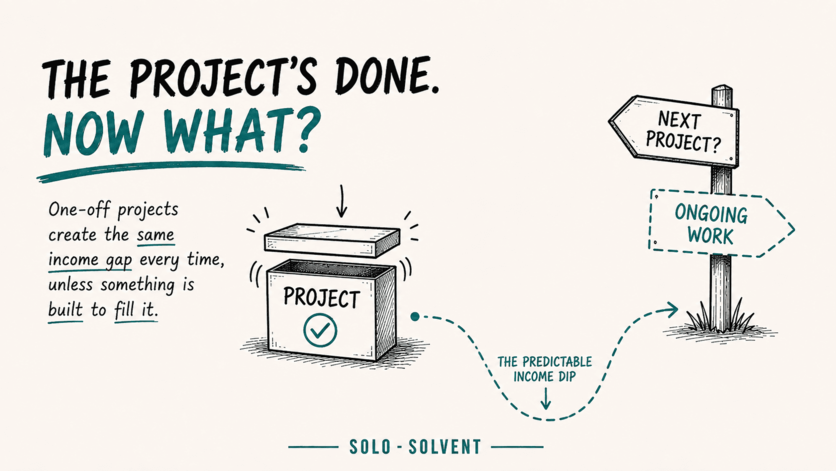
Every project has a start and a finish built into the job itself. You scope it, you deliver it, you invoice it, and then there is nothing left unless the client commissions something new.
That is not a flaw in how you work. It is simply what a project is. The problem is what happens next.
The moment a project ends, you are back to finding the next one. If that happens after every single project, you are not dealing with the odd quiet month. You are dealing with a structural pattern, the Pipeline Gap, built into your business by the way your work is scoped and sold.
This sits at the heart of the feast and famine cycle: a strong month of delivery followed by a scramble to find the next piece of work, because nothing was set up to carry income between projects. It is also why keeping your pipeline consistent between projects matters just as much as the retainer conversation itself.
Prefer to Watch?
Here’s a short video breakdown of the main idea and one practical step you can apply today.
The Real Reason Retainer Conversations Fail
It’s easy to assume a failed retainer pitch is a confidence problem, or a pitching problem. In practice, it rarely is.
The more common issue is a mismatch between what you are offering and what the client has left to spend. If a client has just paid for a project, they have often stretched their budget to afford it. Asking them to commit to a second, larger ongoing fee straight afterwards is a big ask, even if the service is genuinely valuable.
This is especially common where the retainer on offer is a long-term, slow-to-prove service. SEO is a clear example. It typically takes six to twelve months of consistent work to show meaningful results. That is a hard sell to a client who has just spent their budget and has not yet had time to see a return on the original project.
The result is predictable. The retainer conversation either does not happen, or it happens and goes nowhere, and the client disappears until the next time they need something built.
When to raise the retainer conversation
Timing changes the outcome more than wording does.
The best moment to raise an ongoing arrangement is not at project handover. It is slightly later, once the client has had a chance to see some value from what was delivered. A result moving in the right direction, a problem that has clearly been solved, a first sign that the work is paying off.
At that point, the client can feel what they are protecting, rather than being asked to imagine it. That is a fundamentally easier conversation than pitching more work at the exact moment the original project is closing.
How to Size a Retainer Offer a Client Can Actually Say Yes To
If a client cannot afford your full ongoing service, the answer is not to drop the idea of a retainer altogether. It is to offer a smaller version that matches their remaining budget.
For example, rather than pitching a full SEO retainer immediately after a website build, a smaller maintenance style offer, covering updates, fixes and ongoing support, is often a more realistic first step. It solves a problem the client can already feel (their new asset needing looking after) rather than one they have to take on trust (rankings that will improve over many months).
This does not replace a larger retainer conversation. It simply gives you a way to keep the relationship live and paying, instead of losing the client entirely between projects.
The Right-Sized Retainer Framework
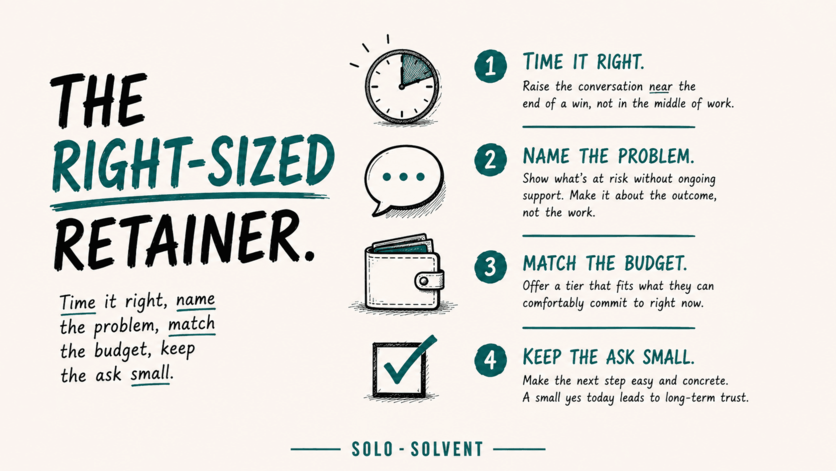
A simple framework for raising this conversation without it feeling like a hard sell:
1.Time it to a proven result. Raise the retainer once the client has seen some value from the project, not at handover and not months later once they have moved on mentally.
2. Name the problem, not the service. Lead with the specific thing that will trip them up next (updates, fixes, someone to call) rather than the name of a package.
3. Match the offer to their remaining budget. If they cannot afford your full ongoing service, offer a smaller, clearly scoped version instead of nothing at all.
4. Keep the ask small and concrete. A simple, specific offer at handover is easier to say yes to than a broader pitch delivered later.
A simple script that follows this structure:
“Now it’s live, the usual thing that trips people up is small changes, updates, things breaking or needing tweaking, and not having anyone to call. I can keep an eye on it for you each month for a set fee so that’s never a scramble. Want me to put together what that looks like?”
This works because it names a felt problem, offers a small and specific fix, and asks for a decision rather than delivering a pitch.
Common Mistakes to Avoid
- Pitching at handover, while the client is still mentally closing the project out.
They have not felt the value yet, so there is nothing concrete for them to protect.
- Offering only your full-priced service.
“SEO retainer” means nothing to a client who just paid for a website. “Someone to call when it breaks” means everything.
- Writing off a client after one rejected pitch.
A smaller, better-timed offer later in the relationship often works where the first attempt didn’t.
- Assuming the client already understands the value of staying on.
If they can’t see it yet, no amount of persuasion will manufacture urgency.
Frequently Asked Questions
How do I ask a client to switch from a project to a retainer?
Raise it once they have seen a result from the completed project, not at handover. Lead with the specific problem an ongoing arrangement solves for them, rather than the name of the service, and keep the offer small enough to match what they have left to spend.
Why won’t clients agree to a retainer after a one-off project?
Most have just spent their budget on the project itself and are not yet ready to commit to a second, longer-term fee, especially for a service where results take time to show. A smaller, more clearly scoped offer is often a more realistic first step.
What is the best time to offer a retainer?
Shortly after the client has seen some tangible value from the original project, rather than at the point of handover or long after they have mentally closed the project out.
What if a client cannot afford my usual retainer rate?
Offer a smaller, clearly scoped version instead of dropping the idea entirely. A modest ongoing arrangement is far better for your pipeline than losing the client until the next project.
Is it normal for one-off project clients to disappear after the work is done?
Yes, if there is no ongoing offer in place. This is a structural pattern, not a sign the work was poor. It is one of the clearest examples of the Pipeline Gap in a project-based service business.
Where This Leaves You
If your income keeps dipping between projects, the fix is rarely a better pitch. It is usually a better-timed, better-sized offer that matches what your client can actually say yes to. If the gap feels more about what you have in reserve than what you are offering clients, building a proper income buffer is worth looking at alongside this.
If you are not sure whether this gap is a pricing problem, a pipeline problem, or something else in your business, the Solo Business Pressure Test will show you exactly where the pressure is sitting right now. It takes a few minutes and it is free.
Read Next
- The Feast and Famine Cycle: Why Solopreneurs Are Trapped In It and How to Get Out– The feast and famine cycle is the pattern most solopreneurs know intimately and almost nobody talks about honestly.
- Why Solopreneurs Stop Marketing When They’re Busy (And Pay For It Three Months Later) – Solopreneurs stop marketing the moment client work fills the diary, because delivery has a deadline attached to it and marketing does not.