A solopreneur lead generation system only works if it survives your busiest weeks, not just your quiet ones. Most lead generation advice assumes a marketing team keeping things moving in the background. Solo service providers don’t have that, so the moment client work fills the diary, marketing stops, and a predictable dry spell follows a few months later.
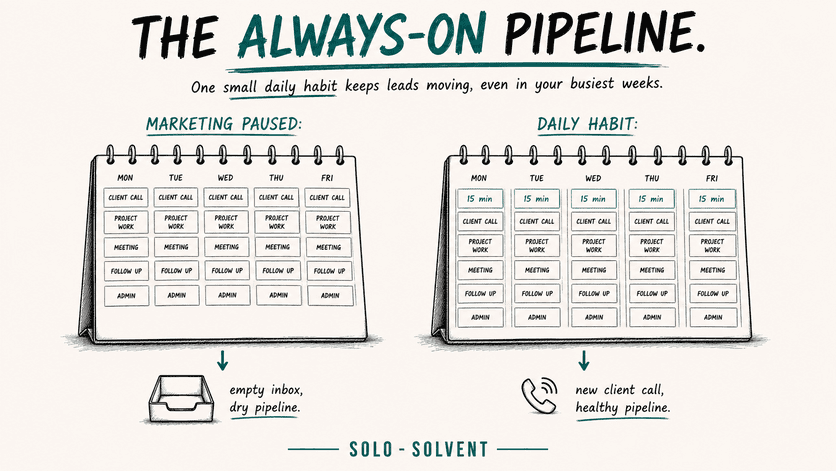
The fix is not a content calendar, a funnel or a marketing plan. It is one small outbound action, done every working day, that takes under fifteen minutes and needs no planning beyond a short list of names.
Why Lead Generation Advice Rarely Works for Solo Service Businesses
Most lead generation advice is written for teams. Post consistently, run a funnel, build a content engine, nurture a list. All of it assumes someone else is available to keep marketing moving while you deliver client work.
In a one-person service business, there is no one else. You are the delivery person and the person responsible for the next piece of work. When a project ramps up, the first thing to get dropped is almost always marketing, because it feels like the safest thing to pause.
That decision rarely feels risky in the moment. The diary is full, the client work is real and urgent, and marketing can obviously wait until things quiet down. It’s a reasonable thought. It’s also the exact thought that creates the gap.
I’ve watched this play out repeatedly in seven years of running my own agency, and in conversations with other solo consultants, designers and copywriters since. The service changes. The decision underneath it never does.
Most solopreneurs don’t lack marketing ideas. They lack a version of marketing small enough to survive a week where every hour is already spoken for. That’s a different problem, and it needs a different fix.
This is closely tied to the structural reasons behind inconsistent solopreneur income, since a pipeline that stalls during busy periods is one of the clearest drivers of feast and famine income for solo service businesses.
The Real Problem: The Pipeline Gap™
The Pipeline Gap™ is the dry spell that arrives predictably after a busy delivery period, because marketing stopped the moment client work filled the diary. It isn’t bad luck, and it isn’t a sign of poor marketing skill. It’s a timing problem, and it’s structural.
Here’s how it plays out. A solopreneur lands several projects at once. Delivery takes over. Marketing quietly stops, because there’s no time and no perceived need. The projects finish, usually close together, because they often started close together. The inbox goes quiet at exactly the point income needs to keep flowing.
This is one thread inside the wider Pressure Loop™. A thin pipeline doesn’t just cost a quiet month. It changes decision making. When the pipeline is empty, every enquiry starts to feel like the last one available, and that’s exactly what happens to pricing decisions when the pipeline runs thin: rates get set from fear rather than value. Closing the Pipeline Gap takes pressure off pricing too, not just income.
The Pipeline Gap is also easy to misdiagnose. A quiet month can look like bad timing, a slow market or a run of bad luck. Looking back at what actually happened, the gap was usually set in motion weeks earlier, at the exact point marketing quietly stopped. Recognising that pattern is the first step to fixing it.
Prefer to Watch?
The Always-On Pipeline Habit
The system that actually closes the Pipeline Gap is smaller than most solopreneurs expect. One outbound touch, every single working day, aimed at one person from a short list. Nothing more elaborate than that.
Step One: Build a Short Contact List
If you don’t already have a working list, this takes about ten minutes. Go through the last twelve months of invoices, your sent folder and your phone contacts. Note anyone you did good work for, anyone who went quiet mid conversation, and anyone in your industry who occasionally sends you work. Ten names is enough to start.
Step Two: Rotate One Action a Day
Each working day, before opening client work, pick one person from the list and take one action:
- A past client you haven’t spoken to in three months or more. Send a short, specific message asking how things are going. No pitch attached.
- A warm lead who went quiet. Send one genuinely useful thing, an article, an idea or a resource, with no ask attached.
- A referral partner or peer. Send a message naming the specific type of client you’re currently looking for.
- Someone in your professional network. Leave a proper, considered comment on something they’ve shared, not a generic reaction.
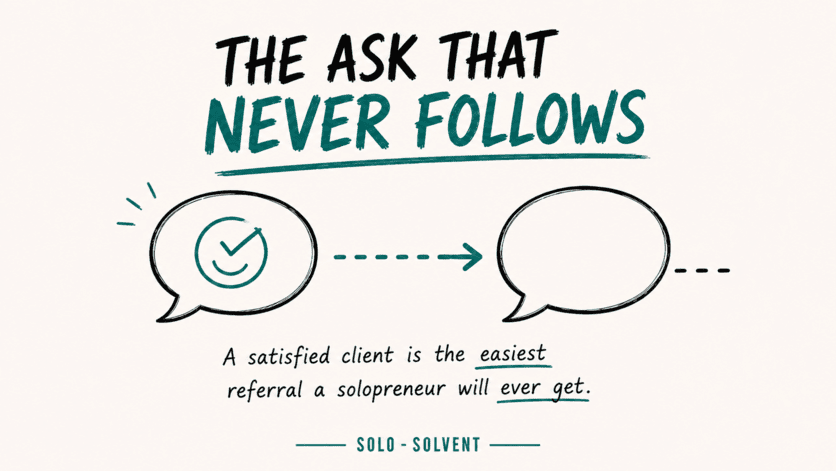
- A past client you did strong work for. Ask directly whether there’s anyone in their circle who might need what you do.
Step Three: Protect the Fifteen Minutes
Do this before email, before client calls, before anything else can take the slot. The habit only works if it happens first, because urgent client work will always claim priority otherwise.
The habit works precisely because it’s small enough to survive the weeks it feels least necessary. Those are the weeks the Pipeline Gap is quietly forming, so those are the weeks the habit matters most.
Why This Isn’t Just Another Content Strategy
It’s worth being clear about what this system is not. It isn’t a posting schedule, a newsletter or a content calendar. Those can support visibility over time, but they take planning and creative energy that simply isn’t available during a busy delivery period.
The Always-On Pipeline habit works because it needs almost none of that. There’s no content to plan, no campaign to design, and no audience to build first. It’s one direct message to one person who already knows you, sent before the day gets away from you.
A steady pipeline habit and a financial cushion that works alongside a steady pipeline habit tend to reinforce each other. One keeps the work coming in, the other stops a single slow week from feeling like an emergency.
Common Mistakes to Avoid
- Waiting until the pipeline is already empty.
By the time the inbox goes quiet, the gap was already set in motion weeks earlier. The habit needs to run continuously, not reactively.
- Confusing marketing with content creation.
Posting online can help visibility, but it isn’t the same as direct outreach to warm contacts. A solopreneur lead generation system needs both, but direct outreach closes the pipeline gap faster because it targets people who already know you.
- Having no defined list.
Without a short list of specific names, the daily habit has nothing to attach to and quietly stops happening within a week or two.
- Sending generic, mass messages.
A message that reads like a template gets ignored. One specific, personal message to one person outperforms a broadcast every time.
5. Dropping the habit as soon as things get busy.
This is the exact failure point the whole system exists to prevent. The habit is designed for busy weeks specifically, not quiet
Frequently Asked Questions
What is a solopreneur lead generation system?
A solopreneur lead generation system is a repeatable way for a one-person service business to keep new work coming in without a marketing team or a large time commitment. In my experience, the version that actually sticks is a small daily outreach habit, not a big campaign that gets planned once and abandoned by week two.
How much time should solopreneurs spend on marketing each week?
Less than most people assume. Fifteen minutes a day, done every working day, has closed the Pipeline Gap for me more reliably than any larger, less frequent push ever did.
What is the Pipeline Gap?
The Pipeline Gap is the predictable dry spell that follows a busy delivery period, because marketing paused the moment client work took over. It’s structural, not a sign of poor marketing skill.
How is the Pipeline Gap different from a normal quiet month?
A quiet month can look like bad timing or a slow market. Look back far enough, though, and the Pipeline Gap was usually set in motion weeks earlier, at the exact point marketing quietly stopped. It’s predictable once you know where to look, not random.
Can solopreneurs generate leads without social media?
Yes. Direct outreach to past clients, warm leads and referral partners tends to outperform social content, and it takes far less time to keep up consistently.
How many outreach messages should I send per day?
One well chosen, personal message is enough. The goal is showing up every working day, not sending more messages on the days you happen to have time.
Read Next
- How the Feast and Famine Cycle Really Works: the structural reasons behind inconsistent solopreneur income.
- Why Solopreneurs Underprice, and How to Stop: what happens to pricing decisions when the pipeline runs thin.
- Building an Income Buffer as a Solopreneur: a financial cushion that works alongside a steady pipeline habit.
- Moving Freelance Clients to Retainers: a second structural fix to the same feast and famine pattern.
Take the Next Step
A steady pipeline habit tells you the Pipeline Gap isn’t your problem anymore. If you’re not sure whether pipeline is actually your most pressing pressure point, or whether pricing, boundaries or your financial buffer needs attention first, the Solo Business Pressure Test takes a few minutes and gives you a clear answer.