
Price freelance services on the outcome the client gets, not on the hours it takes you or what you think they’ll accept. Cost-based pricing, adding up hours and adding a margin, keeps the number tied to your time, which caps what you can earn and turns every negotiation into an argument about hours rather than results.
Value-based pricing starts from a different question: what is this outcome worth to the client, and what does it cost them not to have it? Answer that first, then set the price. The framework below walks through exactly how.
Prefer to Watch?
Here’s a short video breakdown of the main idea and one practical step you can apply today.
Why Fear Ends Up Setting The Price
Most freelancers and solo consultants start with cost-based pricing. Work out the hours, multiply by a rate, add a bit for safety. It feels objective. It isn’t. It ties your price to your time, and time is the one thing that doesn’t scale in a one-person service business.
The real problem shows up when a lead goes quiet, or a client hesitates over the number. That’s when fear takes over the calculator. The price gets shaved down to keep the conversation moving, not because the value changed but because the discomfort did. And with nobody else in the business to catch it happening, that shaved-down number can become the new normal before you’ve noticed the drift.
This is the pattern Solo-Solvent calls the Pricing Trap™: financial pressure causes underpricing, underpricing reduces margin, and the reduced margin increases the pressure that caused it in the first place. Rates set reactively in fear rather than deliberately from value. If this sounds familiar, here’s a closer look at why fear drives pricing decisions and how to stop it.
I priced from fear in the early years of running my own agency. The number moved when I got scared, not when the job changed. Once I could see that pattern instead of just living inside it, the fix wasn’t confidence. It was a different starting question.
Cost-Based Pricing Versus Value-Based Pricing
Cost-based pricing asks “how long will this take me?” Value-based pricing asks “what does this fix, and what’s that fix worth to them?” The second question produces a completely different number, because it has nothing to do with your speed.
That’s the part most pricing advice misses. Getting better at your job under cost-based pricing quietly punishes you. The faster and more efficient you become, the less a time-based price pays you for the same result. Value-based pricing is the only model where getting better actually pays you more, because the price was never about your hours to begin with.
Two freelancers can do near-identical work for near-identical clients and land on very different prices, and both can be right. The value was never in the work. It was in what the work changed for that particular client.
The Four-Question Value Check

This is the practical framework. Before you quote a price, work through these four questions in order. Do it before the call, not during it.
1. What outcome does the client actually get?
Not the deliverable. The deliverable is the report, the website, the campaign. The outcome is what changes in their business because of it.
2. What does it cost them if this doesn’t happen?
Lost revenue, wasted time, a problem that keeps compounding. This is often the real size of the number you’re about to name.
3. What is that outcome worth to someone at their level?
A solo founder and an established company will value the same outcome differently, because the cost of not solving it is different for each of them.
4. What’s the minimum price that keeps this client worth taking on?
Factor in what else you could be doing with that capacity. A price that looks fine on paper can still be wrong if it locks up time you needed for something better, especially if the work could sit better as ongoing rather than one-off. If that’s the shape of it, moving the client onto a retainer may be the better structure than a single value-based quote.
Answer all four honestly and the number tends to present itself. It stops being a guess and starts being a calculation, just not the calculation cost-based pricing taught you to run.
How To Hold Your Price When A Client Pushes Back
When someone says a price is too much, the instinct is to lower it. Resist that instinct and ask a clarifying question first: too much for what, exactly? Often the price isn’t the real problem. The client hasn’t been shown the size of the outcome yet.
There’s also a simple habit worth building. Once you’ve said the number, stop talking. The first person to speak after a price is named is usually the one who weakens their own position, and it is very often the freelancer, filling the silence with a justification nobody asked for.
Hold the pause. Let the client respond first. If they push again, answer with the outcome from question one, not with a smaller number.
Common Mistakes to Avoid
- Pricing by the hour for outcome-based work.
Hourly pricing makes sense for genuinely open-ended tasks. It undersells anything with a clear result.
- Lowering the price before the client has objected.
Pre-emptive discounting, dropping the number before anyone has even pushed back, teaches clients that your first price was never the real one.
- Copying a “market rate” found by guessing or scrolling forums.
Other people’s numbers tell you nothing about the value of your outcome for your client.
- Discounting to win without changing the scope.
If the price comes down, the scope should come down with it. Otherwise you’ve just quietly agreed to work for less.
5. Never revisiting prices once they’re set.
With no one else in the business to flag it, an outdated price can sit unquestioned for years simply because nobody was there to raise it.
Frequently Asked Questions
How do I know if I’m underpricing my freelance services?
A common sign is discounting quickly whenever a lead hesitates, or feeling relief rather than confidence when a client accepts your price. If the number changes with your mood rather than the outcome, that’s underpricing.
Should I charge hourly or by project?
Charge by project or outcome wherever the result is clear. Reserve hourly pricing for genuinely open-ended or exploratory work where scope can’t be defined upfront.
How do I raise prices with an existing client?
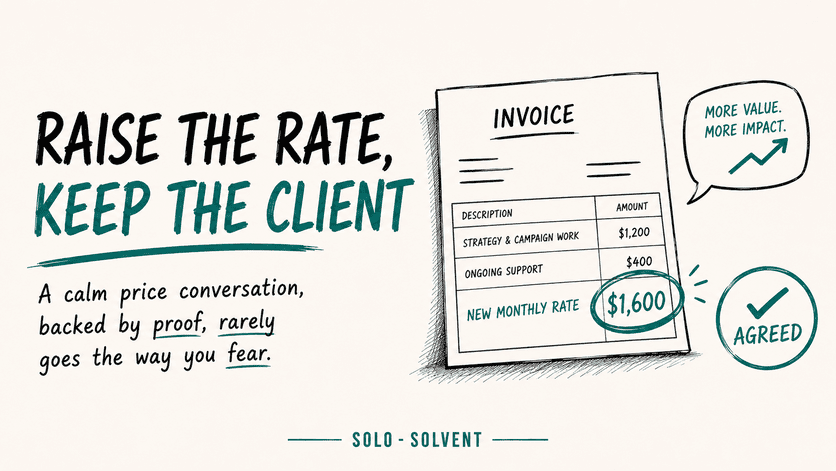
Give notice ahead of the next renewal or project, then state the new price plainly and let it stand. Clients tend to take their cue from how you hold the number, not from how much you explain it.
What if a client says my price is too high?
Ask what “too high” is relative to before you respond. Then restate the outcome, not a lower number. If the value genuinely isn’t there for them, that may be the wrong client rather than the wrong price.
Do I need a rate card or price list?
Not necessarily. A rate card can help with consistency, but value-based pricing means the number should flex with the outcome, so treat any rate card as a starting reference rather than a fixed rule.
How often should I review my pricing?
At minimum once a year, and always before taking on a new type of client or project that shifts what “outcome” means for your work.
Read Next
- How Solopreneurs Underprice Their Work, and How to Stop: a closer look at why fear drives pricing decisions and the rate floor system that helps hold the line.
- How to Move Freelance Clients Onto Retainers : for pricing conversations that extend beyond a single project into ongoing work.
- Building an Income Buffer as a Solopreneur: because a value-based price only holds if there’s a financial floor underneath it that isn’t panicking every slow month.
One Step To Take This Week
If you want a clearer picture of where pricing sits inside your own pressure points right now, the Solo Business Pressure Test takes a few minutes and shows you exactly where to look first.