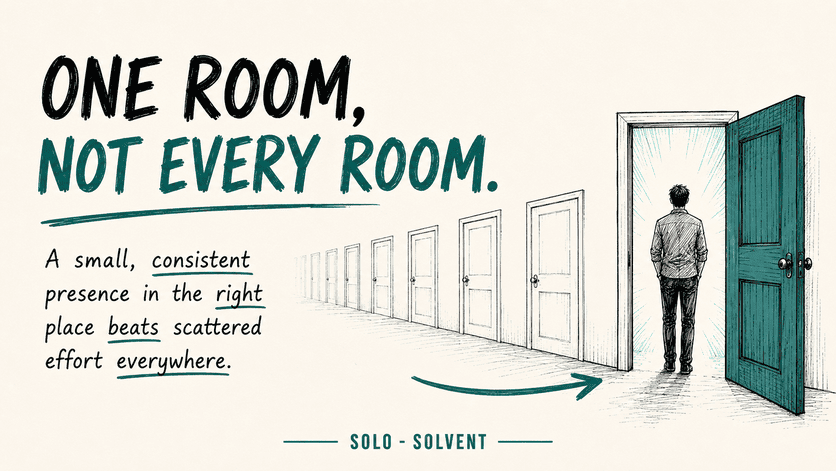
You do not need to be on every platform to become visible as a solopreneur. You need one consistent visibility system, in one place your ideal clients already spend time.
Most solopreneurs either try to show up everywhere at once, or rely on referrals and hope the phone keeps ringing. Both approaches fail for the same reason: neither is a system.
A minimum viable visibility system means choosing one channel and posting one useful thing there every week, consistently, until the right people start to notice.
Why Solopreneur Visibility Usually Fails
For a service-based solopreneur, visibility is not a nice-to-have. You are the delivery person and the marketer at the same time, and there is no one else in the business to pick up the slack when marketing gets ignored. If you stop being visible, you do not get a warning. You just stop being found.
This connects directly to the Pressure Loop™. When visibility depends entirely on referrals or word of mouth, it works fine right up until it does not.
The moment that quiet channel dries up, so does the pipeline behind it, and the gap arrives with no notice. That gap has a name: the Pipeline Gap™, the dry spell that shows up after a busy period because nothing was kept warm while the diary was full.
If that pattern sounds familiar, it is worth understanding why solopreneur pipelines dry up after busy periods before trying to fix visibility in isolation.
Most solopreneurs respond to this in one of two unhelpful ways.
Two Failure Modes
Trying to perform everywhere.
Posting daily across five platforms, chasing algorithms, treating content like a second job on top of the actual work. This is exhausting, unsustainable, and usually abandoned within a few months because there is no time left to deliver client work.
In practice, most solopreneurs who try this stop posting the moment a demanding client project lands, which means the platforms go quiet exactly when consistency would matter most.
Relying entirely on referrals and network.
This works at the start of a solo business, when an existing network provides the first few clients. It runs out fast.
Once that network is exhausted, there is nothing behind it, and the business becomes dependent on someone else remembering to mention your name at the right moment. Service-based solopreneurs who rely solely on this often describe long stretches with no clear sense of where the next client is coming from, even while doing strong work for the clients they already have.
Breaking that dependency usually means building a solopreneur lead generation system that survives busy weeks rather than waiting for the phone to ring.
Neither of these is a strategy. They are both the absence of one.
Prefer to Watch?
Here’s a short video breakdown of the main idea and one practical step you can apply today.
The Real Problem Is Not Confidence, It Is Systems
Solopreneurs who avoid visibility are often told the problem is confidence, or that they need to be more outgoing, more comfortable self-promoting, more willing to put themselves out there. That diagnosis misses the point.
The real problem is that most visibility advice assumes performance. Stand up at events. Post constantly. Sell yourself loudly and often.
For a service-based solopreneur already stretched across delivery, sales, admin and everything else, that model is not sustainable, regardless of personality. It is a systems gap wearing a confidence costume.
A visibility system that survives contact with a busy client week does not need to feel like performance. It needs to be small enough to keep doing every single week, whether the week is quiet or slammed.
This matters more for solopreneurs than it does for a marketing team inside a larger business. There is no colleague to keep the content calendar moving while you focus on delivery. Whatever visibility system exists has to survive being run by one person, alongside everything else that person is already doing.
The Minimum Viable Visibility System
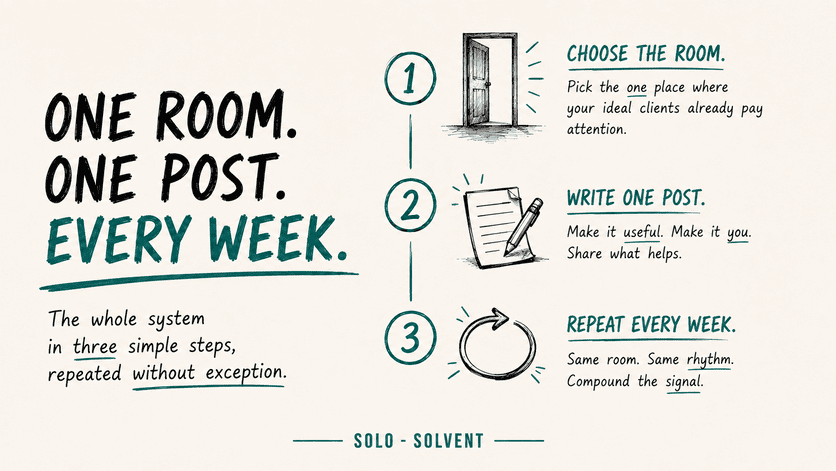
This is the practical framework: one room, one weekly post, repeated without exception.
Step 1: Choose one room
Pick the single place your ideal clients are already spending time. This might be one LinkedIn feed, one local business network, one online community, or one email list. Not five platforms. One.
The test is simple. Where do the people you want to work with already look for answers, recommendations or advice? That is your room. Everywhere else can wait.
Step 2: Post one useful thing, every week, on the same day
Not a sales pitch. Not a personal update. One genuinely useful piece of thinking from the work you are actually doing.
This could be a mistake you fixed for a client this week, a question someone asked that other people are quietly wondering too, or a pattern you keep noticing that nobody else in your space is naming out loud. Specificity matters more than polish.
A short, specific example from real client work will almost always outperform a generic tip, because it shows the reader you actually do the work you are talking about.
A useful way to test a draft post before publishing it: would this be equally true on a generic marketing blog, or could only someone doing this work every day have written it? If it could appear anywhere, it is not specific enough yet.
Step 3: Let consistency do the work
The system does not depend on any single post going well. It depends on being present, reliably, in the same room, for long enough that people start to associate you with the problem you solve.
This will not feel like it is working in week one, or week five. That is normal.
I ran my own agency for years relying on nothing but referrals and the odd networking event, and the quiet weeks always arrived without warning. Visibility built through consistent weekly presence compounds slowly and then becomes obvious, usually around the point someone in that room has the exact problem you keep talking about and your name is the one they think of first.
Minimum Viable Visibility Checklist
- Pick one platform or community where your ideal clients already are
- Set a fixed day and time to post, every week, without exception
- Write from real client work, not general advice
- Skip anything that reads like a sales pitch
- Give it a minimum of twelve weeks before judging whether it is working
- Track only one thing: did you show up this week, yes or no
Common Mistakes to Avoid
- Judging it too soon.
Quitting after two or three weeks because nothing has visibly happened yet. Twelve weeks is the minimum before this kind of consistency starts to show a result, and most people give up long before that.
- Posting sporadically instead of consistently.
A brilliant post every six weeks does not build recognition. A useful post every week does, even when no individual post feels remarkable.
- Writing for everyone instead of the room you chose.
Generic advice that could suit any audience dilutes the point of picking one room in the first place. The more specific the post is to your actual clients, the more it works.
- Waiting until the pipeline is already dry to start.
Visibility takes time to compound. Starting the week the diary empties means starting several months too late.
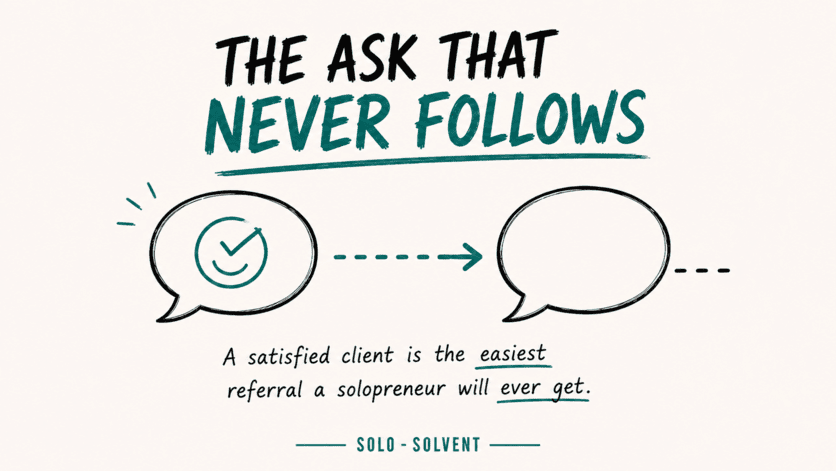
5. Avoiding the referral ask entirely.
Visibility and referrals are not competing strategies. A short, direct ask to existing clients costs nothing and often gets ignored for the same reason visibility gets ignored: it feels exposing to ask.
That reluctance is closely tied to the loneliness of running a business alone, where there is no colleague to nudge you into asking, so it simply does not happen.
Frequently Asked Questions
What is a minimum viable visibility system?
It is the smallest repeatable version of a visibility strategy: one platform, one weekly post, done consistently, rather than a broad content plan across multiple channels.
How many platforms should a solopreneur be visible on?
One, to start. A single channel done consistently outperforms several channels done occasionally, especially for a solopreneur who is also the one delivering client work.
How often should I post to generate inbound leads?
Weekly, on a fixed day, is usually enough to build recognition without becoming a second job. Consistency matters more than frequency.
Do I need to be an extrovert to build visibility as a solopreneur?
No. A minimum viable visibility system is built around consistent, useful posting rather than performance, so it works for quieter personalities as well as outgoing ones.
What is the difference between visibility and marketing?
Visibility is being known and recognised by the right people over time. Marketing includes visibility but also covers pricing, positioning, and the wider client-generating system around it.
Why does visibility dry up after a busy period?
Because marketing usually stops the moment client delivery fills the diary. That gap between delivery and the next paying client is the Pipeline Gap™, and it shows up on a predictable schedule if nothing is kept warm during busy periods.
Read Next
- How to Build a Solopreneur Lead Generation System That Survives Busy Weeks. A repeatable way to keep new client leads coming in, even during heavy delivery weeks.
- Why Solopreneur Pipelines Dry Up After Busy Periods. The Pipeline Gap™ explained, and how to stop it arriving on schedule.
- The Loneliness of Running a Business Alone: Solopreneur Isolation Explained. Why decisions like the referral ask feel harder alone, and what helps.
Not Sure If Visibility Is Your Real Pressure Point?
If visibility is not actually your biggest pressure point right now, it helps to know that before spending months fixing the wrong thing. The Solo Business Pressure Test is a free, few-minute diagnostic that shows you where the real pressure sits in your business.